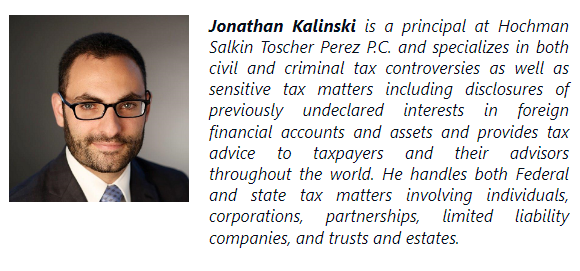
We are pleased to announce that Michel Stein, Edward Robbins, Jr. and Jonathan Kalinski will be speaking at the upcoming Strafford webinar, “Appealing IRS Penalty Abatement Denials: Foreign Disclosure Penalties and Navigating the Appeals Process” on Wednesday, September 6, 2023 from 10:00 a.m. – 11:30 a.m. (PST).

The IRS employs strict standards for determining whether a taxpayer qualifies for penalty abatement for failure to file required foreign information returns and FBARs.

In recent years, the U.S. Treasury Inspector General for Tax Administration issued a report showing that IRS controls over penalties were deficient, leading to incorrect abatement in a large percentage of tested cases. As a result, the IRS has increased scrutiny over foreign penalty abatement requests.

IRS audits have not become more manageable. Once chosen, a taxpayer can expect to face a probing investigation, potentially leading to stiff penalties. Critical to navigating the FBAR and foreign information reporting forms appeals process is understanding the legal standards, the potential penalty level, arguments (legal and otherwise), and evidence to assemble. Counsel and advisers must prepare to present a comprehensive and cohesive case for taxpayers seeking to appeal their FBAR and other penalties.

Listen as our experienced panel of advisers provides a practical guide to navigating the process for handling penalty abatement denials. Attendees will receive an insider’s look at how leading practitioners resolve complicated international controversies.

We are also pleased to announce that we will be able to offer a limited number of complimentary and reduced cost tickets for this program on a first come first serve basis. If you are interested in attending, please contact Sharon Tanaka at sht@taxlitigator.com. 

Click Here for More Information.

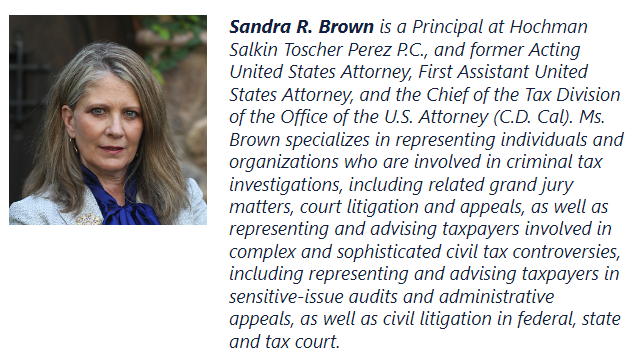
We are pleased to announce that Sandra R. Brown will be speaking on upcoming seminars at the 40th Symposium on Economic Crime – Jesus College, University of Cambridge, being held at Jesus College, a College within the University of Cambridge, September 3–10, 2023. Sandra will be participating on the following panels

Recent United States initiatives to enforce integrity 
Tuesday, September 4, 2023, 4:15 p.m. – 5:00 p.m.

Aiding, abetting and assisting – the facilitation of Tax Crimes
September 5, 2023, 4:15 p.m. – 5:15 p.m.

FATCA Information Loophole —Where “Enablers” Facilitate International Tax Fraud Through The U.S. Financial System
September 6, 2023, 10:45 a.m.

Forty years ago, Jesus College, Cambridge hosted the first Cambridge International Symposium on Economic Crime in the hope that bringing together those concerned about the damage economically motivated crime can and is doing to our economies and, thus the stability and security of our societies, would foster greater understanding and co-operation. The objectives of the Fortieth Symposium remain unchanged. The Cambridge symposium on economic crime is a unique event providing governments, institutions and the academy an opportunity to consider and address, from a practical standpoint, a host of threats to our economic wellbeing and prosperity. Over 600 expert speakers from around the world will focus on an array of issues of concern to those, whether in government, regulation and compliance or just looking after other people’s wealth, posed by fraudster, money launders, organized criminals, terrorist or well-meaning legislators and enforcers trying to protect us, but arguably utilizing disproportionate or inappropriate tools. The primary focus, however, for our fortieth program is simply – integrity. We will explore its importance in our public and private lives and how we can best nurture and protect it. Of course, there are no easy answers and trade-offs are inevitable. 

Click Here for More Information 

This column summarizes recent developments in the IRS’s civil enforcement of the employee retention credit (ERC), with a focus on its examinations. The IRS has been active in alerting taxpayers and tax professionals regarding attempts to promote ERCs to ineligible taxpayers, recently including ERC schemes on its 2023 Dirty Dozen list (News Release IR-2023-71).

Click Here to Read More

In a recent announcement, titled: “IRS cautions plan sponsors to be alert to compliance issues associated with ESOPs” (IR-2023-114, dated August 9, 2023), the Internal Revenue Service (IRS) highlighted its expanded efforts to ensure high-income taxpayers pay their fair share of taxes. The focus of this announcement is on compliance issues associated with Employee Stock Ownership Plans, so-called ESOPs. We discuss the key takeaways from the IRS’s warning and the implications for businesses and individual taxpayers.

Click Here to Read More

Introduction:

The recent case of Farhy v. Commissioner has brought attention to an essential aspect of the tax collection process – the assessment authority for penalties by the Internal Revenue Service (IRS). Ed Robbins, who argued this case on behalf of the taxpayer, explains the impact of this taxpayer’s victory in the latest volume of CCH’s Journal of Tax Practice & Procedure. A copy of this article is available below.  

In this case, the IRS attempted to enforce penalties against a taxpayer for failings to file Form 5491. However, the Tax Court ruled that the penalties were not validly assessed because the IRS does not have assessment authority. This blog post explores the significance of assessments in tax collection and the implications of the Farhy case for taxpayers and the IRS. Also, the article provides an over of penalties to which the determination of missing assessment authority could extent.

Understanding Assessments in the Tax Collection Process:

An assessment is a pivotal event in a taxpayer’s tax liability journey, representing the IRS’s official determination of the amount owed. The Code grants the Commissioner of Internal Revenue the authority to make these assessments, which are recorded in the office of the Secretary according to rules and regulations prescribed by the Secretary. Importantly, an assessment is the trigger for the IRS’s unique collection powers under the Code.

The Farhy Case: Highlighting the Importance of Proper Assessments Authority:

Farhy v. Commissioner serves as a vital lesson for taxpayers and the IRS alike. The Tax Court ruled that without a valid assessment authority, the IRS’s administrative collection powers are non-existent. Consequently, the IRS cannot assess certain penalties and, thus, cannot proceed with collection actions against a taxpayer. The implications of this case extend to most foreign information penalties in Chapter 61 where the IRS lacks assessment authority. As a result, taxpayers facing such penalties should consider raising the issue of the IRS’s lack of authority and file a protective claim for a refund if they have already paid the penalty.

The Timely Appeal and Reminder for the IRS:

The IRS appealed the Fahry decision just before the appeal deadline expired.

However, this case serves as a poignant reminder to the IRS to strictly validate whether they have the proper assessment authority. The case underscores the importance of turning “square corners” in the tax collection process.

Conclusion:

Farhy v. Commissioner highlights the critical role of assessments in the tax collection process. Taxpayers must be aware of their rights and protections under the law, and if facing collection actions by the IRS, you need to consult with a qualified tax professional. For the IRS, this case serves as a reminder to adhere to proper procedures, ensuring that assessments are conducted accurately and lawfully. By turning square corners and following the tax code’s letter and spirit, the IRS can foster a fair and transparent tax system that benefits both taxpayers and the government alike.

Click Here for Article

In an effort to combat tax evasion and abusive tax transactions, the Internal Revenue Service (IRS) and the U.S. Treasury Department have recently released proposed regulations targeting monetized installment sale transactions. These transactions, along with substantially similar schemes, have been classified as listed transactions—a category of reportable transactions that requires special disclosure and reporting.

Click Here to Read More

We are pleased to announce that Philipp Behrendt will be speaking at the upcoming California Lawyers Association webinar “The Use of AI for Tax Litigation,” Tuesday, August 8, 2023, 12:00 p.m. – 1:00 p.m. (PST).

The webinar will delve into the transformative impact of artificial intelligence on tax litigation practices. Attendees can look forward to gaining valuable knowledge on the use and still existing limitations of AI tools and techniques that can be employed by tax professionals. The speakers will also address the ethical considerations surrounding the use of AI in this context, ensuring a holistic understanding of the topic. The program will assist attendees to uncover the strategies for effective prompt engineering, leveraging AI for optimal results.

Click Here to Register

Our partners, Dennis Perez and Sandra Brown, had the privilege of speaking in San Diego on Friday at the 8th Annual USD School of Law- RJS LAW Tax Controversy Institute. 

Joining Dennis Perez on the Government Loans Panel, which provided an in depth focused on PPP, EIDL and ERC audit and fraud issues, were AUSA Dylan M. Aste, Special Litigation Counsel Joseph Orabona, and IRS CI SSA Jason Powell as well as moderators Kaveh and Sam Imandoust. 

Sandra Brown was joined on the Criminal Tax Investigations and Prosecution panel by the Honorable Allison H. Goddard, former AUSA Daniel Silva, and former IRS CI Chiefs Don Fort and Victor Song. Always nice to present with former colleagues and a bonus to learn various tips about federal court procedures and sentencings from Magistrate Judge Goddard.

Many thanks to Ronson J. Shamoun for co-hosting such an informative conference event, and to our tremendous panelists for their enlightening comments on these interesting tax controversy topics.

We are pleased to announce that Steven Toscher, Michel Stein, and Philipp Behrendt will be speaking at the upcoming CalCPA webinar “Cryptocurrency Compliance 2023,” Tuesday, August 8, 2023, 9:00 a.m. – 10:00 a.m. (PST).

Keep abreast of the IRS’s continuous efforts to enhance compliance in the crypto space. Join us for a practical look at the IRS enforcement strategy, established reporting principles as well as recent guidance on digital assets taxation. The Program is your guide to navigating the intricacies of digital asset taxation. Gain valuable insights what the IRS positions on many hot topic items in the world of digital asset taxation actually is, allowing you to provide expert guidance to your clients. Being up to date ensures you can offer the most current and relevant solutions to your clients. We also address how to ensure FBAR compliance and explore voluntary disclosure practices to protect your clients’ interests.

Click Here for More Information

Please join us July 28, 2023 for the CalCPA 2023 Annual Income Tax Seminar.

We have an excellent line up of programs –

How to Help an Individuals with Unreported or Misreported Crypto Transactions
(8:05 a.m. – 9:25 a.m. PST)
Featuring Evan Davis

R&D Credit Hot Topic and California Considerations
(1:05 p.m. – 2:20 p.m. PST)
Featuring Cory Stigile

The Annual Income Tax Seminar is a collaboration of CalCPA and the California Lawyers Association Taxation Section that will provide comprehensive insights into critical topics shaping the world of taxation. This event is tailored for tax professionals, CPAs, attorneys, and financial advisors seeking to stay at the forefront of the industry.

Click Here for More Information

« Newer Posts - Older Posts »

Categories