Posted by: Steven Toscher | October 9, 2023

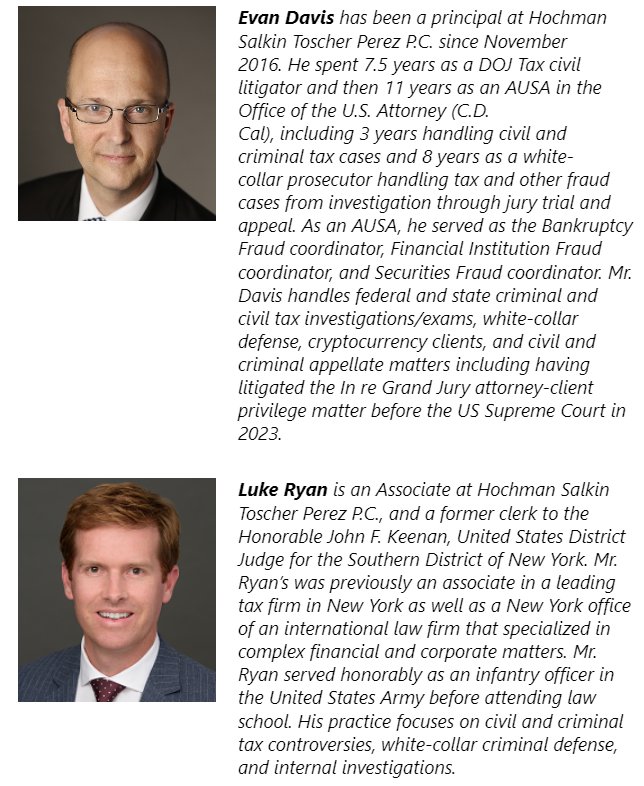
Hochman Salkin Toscher Perez P.C. Welcomes Associate LUKE RYAN

Luke Ryan’s practice focuses on civil and criminal tax controversies, white-collar criminal defense, and internal investigations. Luke joined the firm in 2023, after relocating from New York City to Los Angeles. While in New York, Luke was an associate in a leading tax firm, and he clerked for the Honorable John F. Keenan, United States District Judge for the Southern District of New York. Prior to joining Judge Keenan’s chambers, Luke was an associate in the New York office of an international law firm that specialized in complex financial and corporate matters. Luke served honorably as an infantry officer in the United States Army before attending law school.

Luke has represented clients in a variety of tax, white-collar, and regulatory enforcement matters. While in New York, Luke assisted in representing individuals and companies under investigation or indicted for alleged fraud, securities, and tax-related offenses, including a defendant who was charged with wire fraud conspiracy, defrauding the United States, and other offenses. Luke also served on a variety of teams representing financial institutions and employees in complex regulatory and internal investigations, he represented companies in civil litigations involving appeals of improper administrative acts by agencies of the City and State of New York, and he second-chaired a pro bono criminal appeal argued in the New York Appellate Division-First Department and subsequent criminal leave application to the New York Court of Appeals.

Click Here for Luke’s Biography

We are pleased to announce that Steven Toscher, Michel Stein, and Sandra Brown will be speaking at the upcoming Strafford webinar “Conservation Easement Tax Issues: Recent IRS Enforcement, Structuring and Defending Easement Transactions” Tuesday, October 10, 2023, 10:00 a.m. – 11:30 a.m. (PST).

The IRS has significantly increased enforcement actions for syndicated conservation easements. This crackdown on conservation easement transactions forces taxpayers, tax counsel, and advisers to identify and recognize key tax issues in structuring these transactions.

A conservation easement is a legally enforceable perpetual land preservation agreement between a landowner and either a government agency or a qualified land protection organization (such as a land trust) for the conservation of the land and its resources. Grantors within these transactions can take advantage of significant tax benefits so long as the easement meets IRS approval where there is a donation.

Typically, charitable deductions are not allowed for these transactions, but IRC Sections 170(h)(1) through (h)(5) and Treas. Reg. 1.170A-14 provide for an exception. A charitable contribution deduction is allowed for the fair market value of the conservation easement donated to certain charitable organizations, subject to a limitation on the amounts.

Limitations on the deduction lead to the setup of syndications to purchase land for the conservation easements. This results in high deductions for taxpayers and heightened scrutiny by the IRS.

The panel will review these and other crucial issues:

  • What are the key tax considerations for structuring conservation easements?
  • What are the income regulations applicable to conservation easement transactions?
  • What factors are considered by the IRS in reviewing conservation easement transactions?
  • How can taxpayers and their counsel effectively defend and litigate conservation easement tax issues?

Click Here for More Information

The Internal Revenue Service (IRS) announced (IR-2023-166, September 8, 2023) a significant shift in its tax compliance efforts, aimed at addressing the fairness of the tax system by focusing more attention on high-income earners, partnerships, large corporations, and promoters who abuse tax laws. Statements by Commissioner Danny Werfel indicate that the IRS will be using funding from the Inflation Reduction Act and leveraging improved technology, including Artificial Intelligence, to better detect tax cheating, identify emerging compliance threats, and improve case selection tools to avoid burdening taxpayers with needless no change audits. The IRS plans to increase the audit rates for wealthy individuals, partnerships, and other high earners who have seen a significant decline in audit rates over the past decade. At the same time, the audit rates for those earning less than $400,000 per year will not increase.

Key elements of this major expansion in high-income/high wealth and partnership compliance work includes:

Largest Partnerships Leveraging Artificial Intelligence (AI). In 2021, the IRS launched the first stage of its Large Partnership Compliance (LPC) program with examinations of some of the largest and most complex partnership returns in the filing population. By the end of the month, the IRS will open examinations of 75 of the largest partnerships in the U.S. that represent a cross section of industries including hedge funds, real estate investment partnerships, publicly traded partnerships, large law firms and other industries.

Greater Focus on Partnership Issues through Compliance Letters. The IRS has identified ongoing discrepancies on balance sheets involving partnerships with over $10 million in assets, which is an indicator of potential non-compliance. Taxpayers filing partnership returns are showing discrepancies in the millions of dollars between end-of-year balances compared to the beginning balances the following year. This effort will focus on high-risk large partnerships to quickly address the balance sheet discrepancy.  The IRS plans to notify around 500 partnerships though mailings in October.

Prioritization High Income Collection Cases. The IRS will intensify work on taxpayers with total positive income above $1 million that have more than $250,000 in recognized tax debt. Building off earlier successes that collected $38 million from more than 175 high-income earners, the IRS will have dozens of Revenue Officers focusing on these high-end collection cases in FY 2024. The IRS is working to expand this effort, contacting about 1,600 taxpayers in this category that owe hundreds of millions of dollars in taxes.

The IRS also announced (IR-2023-176, September 20, 2023) a plan to establish special pass-through work unit organization to help with high-income compliance efforts, which will be housed in Large Business and International (LB&I). The IRS hopes that the new unit will leverage Inflation Reduction Act funding to disrupt efforts by certain large partnerships to use pass-throughs to intentionally shield income to avoid paying the taxes they owe.  As part of a larger transformation, the IRS recently announced the opening of more than 3,700 position nationwide to help with expanded enforcement work focusing on complex partnerships, large corporations, and high-income and high-wealth individuals.

The IRS appears more ready and able than ever to address perceived non-compliance for the high-wealth individual and their related entities in efforts to close the tax gap and to make for a more equitable tax system. Taxpayers and their representations should stay informed.

UCLA Extension’s 39th Annual Tax Controversy Institute offers a platform to LB&I to showcase its latest efforts.

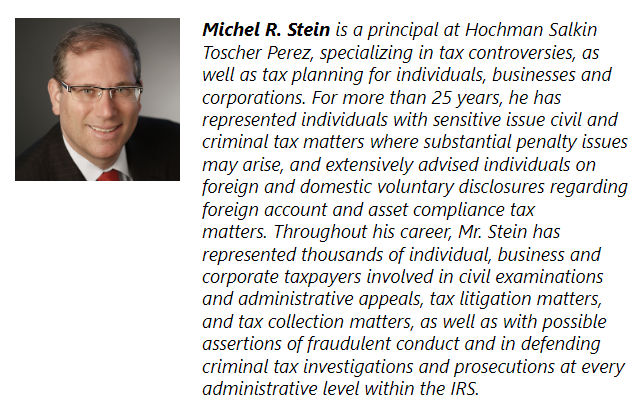
Interested in learning more about LB&I and its focus on high-wealth and large partnerships taxpayers, consider attending UCLA Extension’s Annual Tax Controversy Institute on October 26, 2023. Michel R. Stein will be moderating a panel during the morning session on The New Landscape in IRS Examinations – What Can We Expect in the New Tax Enforcement Environment for High Wealth Individuals and Large Partnerships, with amazing panelists:

Cliff Scherwinski – IRS Director Pass-Through Entities

Eric Cirelli – IRS Director of Field Operations, Global High Wealth

Hans Famularo – IRS Counsel (SB/SE) at Office of IRS Chief Counsel

Phil Wilson – Managing Partner, Costa Mesa Office at Marcum LLP

Michel R. Stein (Moderator)- Principal, Hochman Salkin Toscher & Perez 

UCLA Extension’s Annual Tax Controversy Conference is the preeminent conference exclusively dedicated to tax controversy and tax litigation. The conference provides an open forum for distinguished presenters and panelists to discuss, and often debate, sensitive tax practice issues with an engaged audience. For more information about the UCLA 39th Annual Tax Controversy Institute, click on this link.

We are pleased to announce that Michel Stein, Edward Robbins, Jr. and Jonathan Kalinski will be speaking at the upcoming Strafford webinar, “Appealing IRS Penalty Abatement Denials: Foreign Disclosure Penalties and Navigating the Appeals Process” on Wednesday, October 4, 2023 from 10:00 a.m. – 11:30 a.m. (PST).

The IRS employs strict standards for determining whether a taxpayer qualifies for penalty abatement for failure to file required foreign information returns and FBARs.

In recent years, the U.S. Treasury Inspector General for Tax Administration issued a report showing that IRS controls over penalties were deficient, leading to incorrect abatement in a large percentage of tested cases. As a result, the IRS has increased scrutiny over foreign penalty abatement requests.

IRS audits have not become more manageable. Once chosen, a taxpayer can expect to face a probing investigation, potentially leading to stiff penalties. Critical to navigating the FBAR and foreign information reporting forms appeals process is understanding the legal standards, the potential penalty level, arguments (legal and otherwise), and evidence to assemble. Counsel and advisers must prepare to present a comprehensive and cohesive case for taxpayers seeking to appeal their FBAR and other penalties.

Listen as our experienced panel of advisers provides a practical guide to navigating the process for handling penalty abatement denials. Attendees will receive an insider’s look at how leading practitioners resolve complicated international controversies.

Click Here for More Information

We are pleased to announce that Steven Toscher, Sandra Brown, and Jonathan Kalinski will be speaking at the upcoming CalCPA webinar “Handling Cannabis Tax Examination 2023” Tuesday, September 26, 2023, 9:00 a.m. – 10:00 a.m. (PST).

The sale and distribution of cannabis for recreational or medical use is a powerful economic engine generating billions in annual revenue, with over 40 states and the District of Columbia having some form of legalization of the substance. Despite state relaxation of marijuana prohibition laws, without careful planning, regulated cannabis businesses can be subject to hefty tax assessments and penalties.

Under Section 61, all gross income must be reported from whatever source it is derived. However, under Section 280E, cannabis businesses cannot deduct rent, wages, and other expenses unless it is for cost of goods sold (COGS), resulting in a substantially higher tax rate than other companies on their income. The IRS issued guidance to its agents on conducting audits of cannabis businesses giving IRS agents the authority to change a cannabis business’ accounting method. Under Section 280E, certain costs are not included in COGS. Thus, they remain non-deductible for income tax purposes.

As more states legalize cannabis and make available licenses to grow, manufacture, distribute, and sell cannabis, the IRS has increased cannabis tax audits, which could result in unbearable tax liabilities.

Click Here for More Information

We are pleased to announce that an article entitled “Walking the Tightrope of Employment Tax Law,” by Jonathan Kalinski and Dennis Perez, is featured as the Los Angeles Lawyer Magazine’s September 2023 Cover Story. The article discusses both federal and California worker classification issues and the different standards for each. Now that California has adopted the ABC Test, and with the rise of unemployment claims during the pandemic, businesses in California can expect worker classification audits to skyrocket.

Click Here for the Article

We are pleased to announce that Steven Toscher, Michel Stein, and Robert Horwitz will be speaking at the upcoming Strafford webinar “Federal and State Tax Residency Rules: Latest IRS Examination Guidance and Navigating State Tax Regulations” Thursday, September 21, 2023, 10:00 a.m. – 11:50 a.m. (PST).

This course will guide tax professionals and advisers on the latest IRS examination guidance and state tax law issues regarding taxpayer residency. The panel will discuss federal and state tax residency rules, residency and allocation matters, U.S. income tax treaties, available tax planning techniques, managing nonresident audits, and overcoming state regulatory challenges.

Click Here for More Information

Nestled in the heart of the Caribbean, Puerto Rico beckons with its breathtaking natural beauty, vibrant culture, and alluring lifestyle, making it a tempting living space for those seeking a tropical paradise while enjoying the benefits of living in a U.S. territory. However, those who move to Puerto Rico in whole or in part for tax benefits available only to residents face a complex web of tax incentives and the ever-watchful eye of the IRS seeking to uncover fake residents and improper tax treatment. 

Click Here to Read More

The year 2023 is witnessing transformative changes in the tax landscape for digital assets, with the Internal Revenue Service (IRS) poised to usher in a significant transformation. The official version of the proposed regulations for broker reporting under Code Secs. 6045 and 6045A is scheduled for August 29, 2023. However, ahead of this official release, the Treasury Department granted access to the 282 page unofficial proposed regulations (Proposed Regulation 2023-17565). These regulations outline the requirements for brokers mandated to report sales and exchanges of digital assets by their customers. This pivotal moment has been in the making since the enactment of the Infrastructure Investment and Jobs Act (P.L. 117-58) on November 15, 2021. Importantly, these regulations go beyond broker reporting; they provide comprehensive insights into how the IRS defines and views the world of digital assets, making them a valuable resource for tax professionals venturing into the cryptocurrency arena.

Click Here to Read More

Posted by: Steven Toscher | August 29, 2023

UCLA Tax Controversy Institute is Now Open for Registration

Dear Colleague-

We are pleased to announce that registration is now open for this years UCLA Extension Tax Controversy Institute which will be live this year and held on October 26, 2023 at the Beverly Hills Hotel in Beverly Hills, California. 

The Institute is entering its 39th year and is recognized as one of the premier tax controversy programs in the country. 

We will be covering the most important topics of interest to tax controversy practitioners including —

IRS Examinations for High Wealth Individuals and Partnerships –What to Expect in Tax Enforcement After the Inflation Reduction Act of 2022

Employee Retention Credits – Promoters, (Ghost) Preparers and the Employers Caught in the Middle

Valuation In Tax Cases—Best Practices and Emerging Issues

An Update on Cryptocurrency Enforcement and Voluntary Disclosures

Criminal Tax, Parallel Investigations and Joint Investigations – When Two Worlds Collide

The New IRS Collection Process – The Best Ways to Resolve an IRS Debt

Tax Court Updates

We also have keynote presentations by the National Taxpayer Advocate Erin Collins and the Chief of IRS Criminal Investigation James Lee. We are also pleased to announce that this year’s Bruce I. Hochman Award recipient is retired IRS Area Counsel Sherri Wilder.     

Join us, your fellow practitioners and top government officials for a day filled with critical insights on the hot topics and current developments relevant to all tax practitioners. We are pleased to be fully back in person at the Beverly Hills Hotel which means all attendees will get to enjoy a great lunch program and our traditional evening cocktail party, both of which provide exceptional opportunities to network and gather with old and new tax colleagues alike. 

 Click Here to Register

We look forward to seeing you on October 26, 2023.

Click Here for the Article

« Newer Posts - Older Posts »

Categories