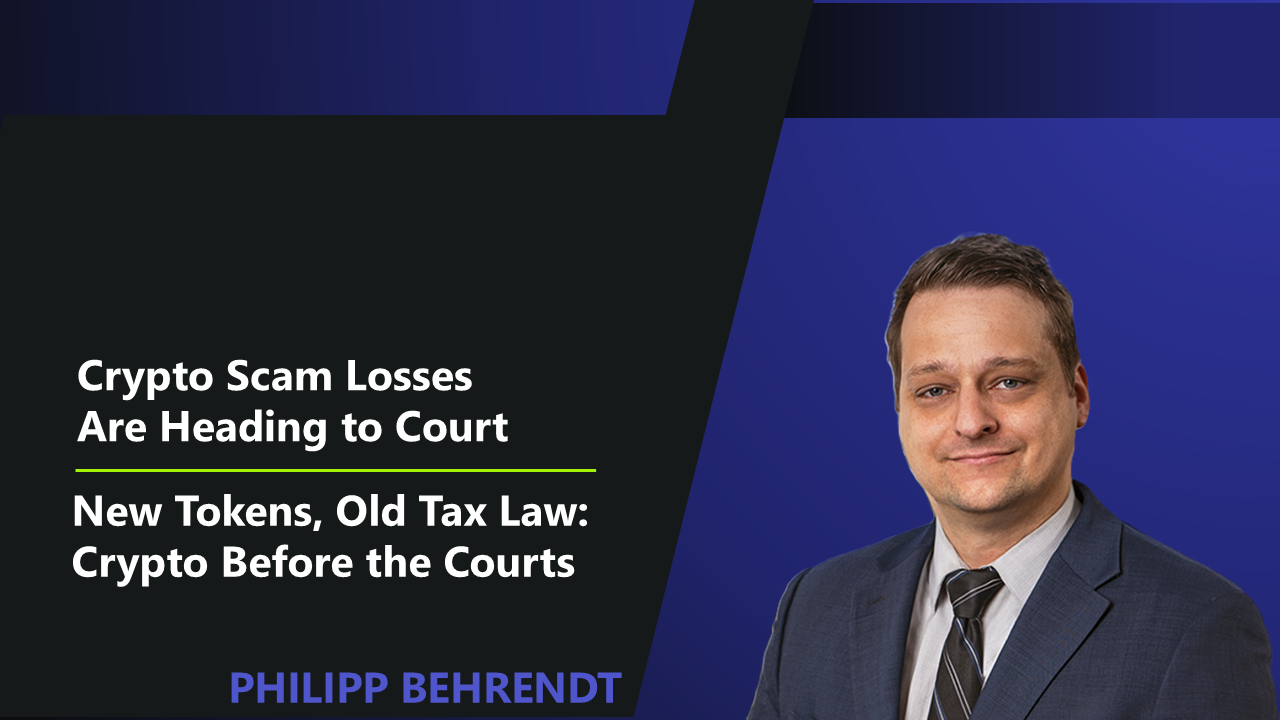
Hochman Salkin Toscher Perez P.C. is pleased to announce that Principal Philipp Behrendt has published two articles in the Journal of Tax Practice & Procedure, examining significant developments in cryptocurrency tax litigation and the application of established federal tax principles to digital assets.
The articles, published in the Summer and Fall 2026 issues, address two increasingly important areas of tax controversy: the deductibility of cryptocurrency scam losses and the taxation of newly created digital assets, including staking rewards.
“Crypto Scam Losses Are Heading to Court” (Summer 2026)
As cryptocurrency-related fraud continues to generate substantial financial losses, taxpayers and the IRS are increasingly disputing whether victims may claim theft-loss deductions under IRC § 165.
The article examines three pending cases, Vaia v. United States, Fry v. Commissioner, and Caputo v. Commissioner, that illustrate the challenges facing victims seeking tax relief. Following the Tax Cuts and Jobs Act and subsequent legislation, most personal theft losses are no longer deductible, making the distinction between personal losses and losses incurred in transactions entered into for profit particularly important.
Philipp analyzes the legal requirements for claiming these deductions, including establishing a theft under applicable state law, demonstrating a profit motive, determining the appropriate year of deduction, and evaluating the reasonable prospect of recovery. The article also addresses the complications arising when victims liquidate retirement accounts to fund fraudulent transactions, potentially creating significant tax liabilities in addition to the underlying loss.
“New Tokens, Old Tax Law: Crypto Before the Courts” (Fall 2026)
When does receiving newly created cryptocurrency constitute taxable income? That question is increasingly reaching the courts as taxpayers challenge the IRS’s treatment of staking rewards and other digital assets.
The article examines Paschall v. Commissioner, Jarrett v. United States, and Rogovy v. Commissioner, exploring how traditional tax concepts such as realization, receipt, and dominion and control apply to blockchain transactions.
Particular attention is given to the distinction between staking through a centralized platform and directly participating in blockchain validation. While the Tax Court in Paschall held that staking rewards distributed through a cryptocurrency platform were taxable upon receipt, Jarrett raises the separate question of whether tokens created through a taxpayer’s own validation activities should be treated differently. Rogovy, involving cryptocurrency received through Bitcoin hard forks, raises additional questions about when taxpayers obtain sufficient control over digital assets to recognize income.
The article also considers the importance of understanding the underlying blockchain technology, the role of expert testimony, and practical considerations for protecting sensitive wallet information during tax litigation.
Digital Assets and the Next Generation of Tax Controversies
Together, these articles illustrate a broader development in cryptocurrency tax enforcement and litigation. While earlier disputes frequently centered on unreported transactions, cost basis, and substantiation, courts are now increasingly confronting more fundamental questions concerning the characterization of transactions, the recognition of income, and the availability of deductions.
As these cases progress, their outcomes may have significant implications for taxpayers, practitioners, and the IRS in applying existing tax law to an evolving digital asset ecosystem.
Both articles are available in the Journal of Tax Practice & Procedure, published by Wolters Kluwer.
Philipp Behrendt is a Principal at Hochman Salkin Toscher Perez P.C., licensed in California as well as in Germany and assists in advising clients in civil and criminal tax controversies as well as international money laundering investigations stemming from tax avoidance structures. He also focuses on the technical aspects involved in advising voluntary disclosures in connection with DeFis, NFTs, and other crypto assets. Philipp is a Liaison to the Young Lawyer Committee for the ABA Tax Section’s Civil and Criminal Tax Penalties Committee and served on the Beverly Hills Bar Association’s Barristers Board of Governors from 2022 to 2023. Philipp is the Chair of the Beverly Hills Bar Association’s Tax Section, a Liaison.
For more information, please contact Philipp Behrendt at behrendt@taxlitigator.com.


Leave a Reply