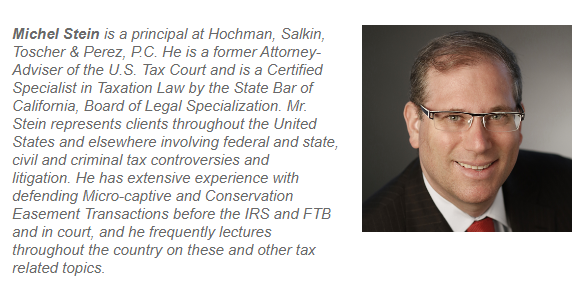
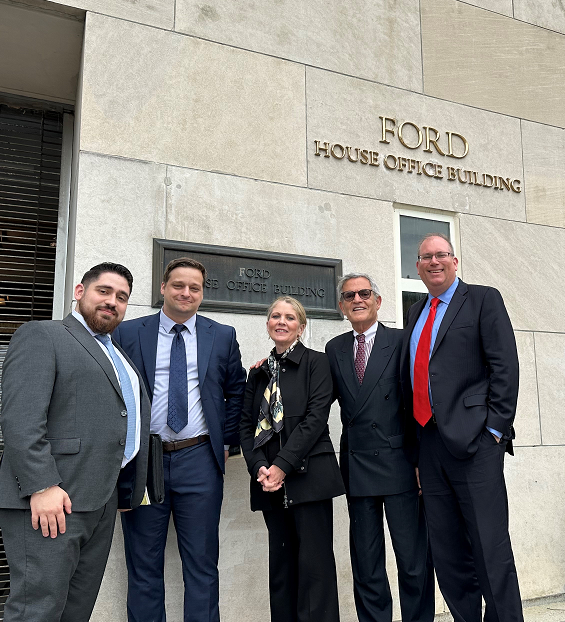
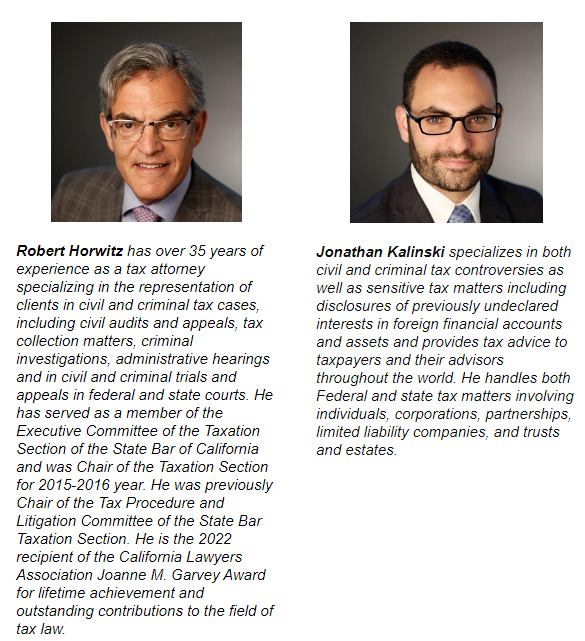
We are pleased to announce that Michel Stein, Evan Davis and Philipp Behrendt will be speaking at the upcoming CPA Academy webinar “New Developments in Cryptocurrency: Reporting and Enforcement,“Thursday, May 11, 2023, 8:00 a.m.– 9:00 a.m. (PST).
This program will provide tax advisers and compliance professionals with a practical look at IRS guidance for calculating and reporting income and gain on cryptocurrency (e.g., Bitcoin) transactions. We will discuss the changes within the IRS as well as the agency’s latest publication on cryptocurrency reporting requirements, NFT, and other updated.
We will address recently released IRS Chief Counsel Advice, the Ethereum merge, and the recent IRS enforcement initiatives to identify digital asset activity. We’ll also discuss how the requirements of voluntary disclosures and the risks of criminal prosecution related to unreported and improperly reported cryptocurrency transactions.
We are pleased to announce that Steven Toscher, Michel Stein and Cory Stigile will be speaking at the upcoming Strafford webinar “IRS High-Wealth Examinations: IRS Wealth Squad, Targeted Issues, Preparation, IDRs, Appeals, and Litigation,” Thursday, May 4, 2023, 10:00 a.m. – 11:50 a.m. (PST).
The IRS Large Business and International Division is auditing high net worth individuals and their related entities, including partnerships, S corporations, trusts, and private foundations. The Wealth Squad, a highly-trained division of the IRS, is conducting these audits.
Although targeting specific areas, these are comprehensive audits covering most aspects of a taxpayer’s tax return. Tax professionals working with high-wealth clients need to prepare for potential examinations and understand how to represent these taxpayers.
Listen as our panel of tax experts provides the latest information on these comprehensive audits, including the IRS selection process, information document requests, supporting documentation, audit adjustments, appeals, and litigation.
The IRS Office of Chief Counsel issued Chief Counsel Advice (“CCA”) 202316008 last Friday regarding the tax consequences of holding a native token to a blockchain distributed ledger that is undergoing a protocol upgrade.
The Tax Court has determined that the IRS lacks authority to assess penalties under IRC § 6038(b) for failing to file Forms 5471, in a recent decision, Farhy v. Commissioner, 160 T.C. No. 6 (T.C. April 3, 2023). As further held by the court, absent such an assessment, the IRS has no administrative authority to pursue collection, including filing of Notices of Federal Tax Liens or issuing Notices of Intent to Levy. While the Tax Court’s decision is limited to the IRC § 6038(b) penalty, its reasoning is applicable to all foreign information return reporting penalties contained in IRC Chapter 61A. Both determinations now raise a flurry of questions as to what actions taxpayers should consider when receiving a penalty notice for the failure to file informational returns, such as the Form 5471, from the IRS.
On April 4, 2023, during his ceremonial swearing-in as the 50th IRS Commissioner, Danny Werfel, announced that the IRS’s strategic operating plan for the nearly $80 billion in funding, under the Inflation Reduction Act (IRA), would be issued later that week, stating there would be “real world improvements for every taxpayer, every tax professional, and every IRS employee.” That day, Janet Yellen, the Secretary of Treasury, gave clear marching orders to Commissioner Werfel, stating that he will be focused on “dramatically improving taxpayer service and ensuring that large corporations and the wealthy pay the taxes they owe.”
When a taxpayer who has not filed a tax return is contacted by an IRS agent, the taxpayer will be requested to give the delinquent return to the agent. Internal Revenue Manual 4.12.1.7.2.1 (10-05-2010) states that the IRS agent is to “[a]dvise the taxpayer to deliver the returns promptly to the examiner along with a written statement explaining why they did not timely comply with filing requirements.” If you have a client in this situation, advise her it is best to not to listen to this particular request by the IRS agent. Instead, the client should first either e-file the delinquent returns or send them by certified mail to the appropriate IRS service center and then provide the IRS agent with a copy of the duly filed return. The reason is that, according to the Ninth Circuit, a taxpayer who complies with an IRS agent’s request for a delinquent return has not legally filed a return with the IRS unless and until the IRS agent has sent it to the appropriate service center. Thus, the statute of limitations for examination of that return will continue to remain open indefinitely. This is what the taxpayer learned in Seaview Trading, LLC v. Commissioner, ___ F.4th ___ 2021 WL 2442606 (9th Cir., March 10, 2023).
We are pleased to announce that we have won a major victory in the United State Tax Court with the Court holding the Internal Revenue Service does not have authority under the Internal Revenue Code to assess penalties for the failure to file Forms 5471. Farhy v. Commissioner, 160 T.C. No. 6, (April 3, 2023). The IRS excessive assessment of foreign penalties has been a concern to the tax practitioner community for a number of years now.
Congratulations to Edward Robbins of our office for helping to establish this important precedent which invalidated the IRS authority to assess these penalties.
Stay tuned. We expect this decision to have a significant impact in the foreign enforcement area. Any taxpayer who has paid these penalties should consult with their tax advisor about filing a claim for refund.
On February 28, 2023, the Supreme Court issued its opinion in Bittner v. United States, ___ U.S. ___, 143 S.Ct. 713, 2023 WL 2247233, holding that the non-willful FBAR penalty is applied per annual report and not per account. For the past few years, the IRS has taken the position that it could impose a separate $10,000 non-willful FBAR penalty based on the number of foreign accounts a U.S. person failed to properly report. The Ninth Circuit rejected the Government’s argument and held the maximum penalty per year is $10,000, United States v. Boyd, 991 F. 3d 1077 (2021), while the Fifth Circuit held the $10,000 penalty could be imposed per account. United States v. Bittner, 19 F. 4th 734 (2021).
On March 7, 2023, the IRS Office of Professional Responsibility (“OPR”) issued an OPR Alert titled Professional Responsibility and the Employee Retention Credit. This OPR bulletin (Issue Number: 2023-02) (the “OPR Alert”), was issued on the same day the IRS issued IR-2023-40, which renewed an October warning to employers about certain third-party advisors in the marketplace urging employers to claim the ERC without appropriately advising about limitations on eligibility and the correct computation of the credit.
Congress enacted four iterations of ERC relief during 2020 and 2021 to encourage “Eligible Employers” to keep employees on their payroll despite experiencing economic hardships related to the COVID-19. The ERC ultimately helped many businesses that continued to pay payroll while shut down due to the pandemic or had significant declines in gross receipts from March 13, 2020 to December 31, 2022. While the refundable ERC in each period was similar in how it was administered by the IRS through a company’s payroll tax filings each quarter, there were important differences in the eligibility requirements for the ERC over this period. Responsible tax professionals did their best to navigate these changes and digest the plentiful IRS guidance during the pandemic. A helpful comparison chart of the 2020 versus the 2021 eligibility requirements is now available on IRS.gov. With the benefit of hindsight, the IRS’s cumulative guidance can help professionals evaluate what transpired since 2020 and advise clients regarding any exposure regarding their ERC positions.
By 2022, tax professionals had called out for IRS guidance and publicity regarding certain promoters who continued to solicit employers to use credits improperly. The IRS’ published warning in IR-2022-183, October 19, 2022, was well received because it gave tax professionals a publication to show to their longstanding client contacts to rebut what the employers heard through third party solicitations. As noted in the OPR Alert, these third-party advisers could charge hefty upfront fees or a fee contingent on the amount of a refund, leading some employers to claim excessive ERCs based on improper positions as to employer eligibility and computation of the credit.
In any event, the OPR Alert highlights some professional obligations to consider regarding ERC positions. For instance, Section 10.22(a) of Circular 230 requires a practitioner to exercise due diligence in preparing and filing tax returns on a client’s behalf. Also, the OPR Alert addresses section 10.34(c), under which a practitioner is required to advise a client of potential penalties on a tax return the practitioner prepares for the client or when the practitioner has advised the client about the position taken. A complication for practitioners addressing the reporting of the ERC is that while ERC benefits are utilized through the filing of an employer’s payroll tax returns (or amended payroll tax returns), obtaining the ERC impacts the ability for a company to deduct such wages on the employer’s income tax filings. Accordingly, return preparers need to consider reported positions on returns they did not prepare in order to properly evaluate the overall ERC reporting positions. In addition, the ERC is restricted in quarters for which wages were reported as payroll costs in obtaining Payroll Protection Plan (PPP) loan forgiveness, or were used to claim certain other tax credits. Also, as noted above, the rules differ depending on the quarter in which the wages were paid.
As foreshadowed in the IRS alerts and notices cited above, the ERC filings for the 2020 and 2021 tax periods, and forthcoming refund claims reflecting ERC benefits for these periods, are ripe for IRS examinations and enforcement. With an extended statute of limitations, the IRS will have additional time to conduct these examinations. Accordingly, tax professionals should review their clients’ reported ERC positions with care and consider their requirements under Circular 230 and other ethical standards when giving advice in this area.
CORY STIGILE – For more information please contact Cory Stigile – stigile@taxlitigator.com. Mr. Stigile is a principal at Hochman Salkin Toscher Perez P.C., a CPA licensed in California, the past-President of the Los Angeles Chapter of CalCPA and a Certified Specialist in Taxation Law by The State Bar of California, Board of Legal Specialization. His representation includes Federal and state controversy matters and tax litigation, including sensitive tax-related examinations and investigations for individuals, business enterprises, partnerships, limited liability companies, and corporations. His practice also includes complex civil tax examinations. Additional information is available at www.taxlitigator.com.
Help us celebrate our 16th Annual “Tee Off For Tierra!” Charity Golf Tournament, benefiting the people with developmental disabilities that Tierra empowers each day through Workforce Development, College to Career and Careers in the Arts. This year’s tournament will take place at North Ranch Country Club in Westlake Village. Registration fees include cart, swag bag, BBQ lunch, dinner reception, & more.
Legal Disclaimer. This Report only provides general information about the law and does not, under any circumstances, constitute legal advice in any manner. The facts of each situation are unique and you should not act or refrain from acting in any manner based on any information contained or referenced in this Report at any time without first obtaining the advice of competent professional legal counsel. This site contains links to third-party internet sites. We are not responsible in any manner for, and make no representations or endorsements of any kind whatsoever with respect to, any third-party internet sites or with respect to any information, products or services that such internet sites might offer or provide.