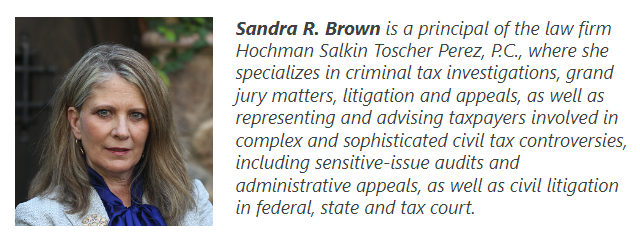
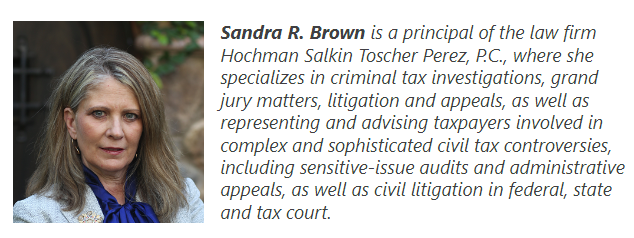
We are pleased to announce that Sandra Brown will be speaking at the upcoming Alvarez& Marsal Tax and Wolters Kluwer Virtual Coffee Talk webinar “Employee Retention Credits” Tuesday, October 31, 2023, 12:00 a.m. – 1:00 p.m. (EST).

The employee retention credit (ERC), enacted as part of the CARES Act, is a US federal tax credit that provides an incentive to employers who continued to employ individuals during the COVID-19 pandemic. Since its enactment, there have been questions as to whether a business qualified and how to interpret what qualified as a full or partial suspension of operations in order to be eligible for the credit. Companies engaged advisors – some of whom were diligent in determining a businesses’ eligibility – though others engaged advisors, whose business models created incentives to take aggressive positions on employee retention credit qualification that likely are not sustainable under audit. The IRS’s focus on fraudulent ERC claims has earned these transactions the #1 spot on the IRS’s annual Dirty Dozen list and has created opportunities for corrective action for those who may have not yet received the claimed credits and are concerned about the legitimacy of their ERC claims. This also puts increased pressure on acquirers in M&A transactions to ensure the appropriate level of diligence was performed, and if not, how buyers can contractually protect themselves in an M&A transaction.

Click Here for More Information

The IRS has recently made big headlines about focusing enforcement initiatives on wealthy individuals, but we have not heard so much about the focus on corporations -until this week. Yes—corporations are part of the tax gap.  

The recent IRS announcements regarding new corporate tax compliance initiatives mark the beginning of a new phase in the relationship between the IRS and large corporations. With the agency taking significant steps to ensure that businesses fulfill their tax obligations, it is essential for corporations to understand these initiatives and get ready to deal with the new reality of a greater focus on corporate compliance.

On October 20, 2023, the IRS released its second quarterly update, shedding light on how Inflation Reduction Act (IRA) funds are being utilized and the implementation of priorities. The update unveiled three corporate tax compliance initiatives, underscoring the IRS’s commitment to holding corporations accountable for their tax responsibilities.

1.      Transfer Pricing Soft Letter Compliance Alerts for Foreign-Owned Corporations: The IRS is set to send “compliance alerts” to approximately 150 U.S. subsidiaries of foreign corporations, indicating potential misuse of transfer pricing tactics to report diminished profits on domestic activities. These alerts suggest it’s time to take a hard look at the company’s transfer policies and practices and start getting ready to head off or prepare for a transfer pricing examination.

2.      Expansion of Large Corporate Compliance Program: In conjunction with its plan to hire 3,700 new revenue agents , the IRS is expanding its large corporate compliance program. The program scrutinizes large corporate taxpayers with substantial assets, meaning average assets of more than $24 billion, and average taxable income of approximately . $526 million per year. The expansion includes initiating an additional 60 audits of major corporations in early 2024 increasing the examination of these businesses. The IRS will apply a combination of artificial intelligence and subject matter expertise in an effort to crack down on noncompliance.

3.       Abuse of Repealed Corporate Tax Break: The IRS emphasized its efforts to address what it considers the abuse of the section 199 deduction for domestic production, which was repealed in the 2017 Tax Cuts and Jobs Act. These efforts have borne fruit, highlighted by a significant victory for the IRS in Bats Global Markets Holdings Inc. v. Commissioner (No. 22-9002, 2023 WL 4482553 (10th Cir. July 12, 2023)).

The IRS’s corporate tax compliance initiatives represent a significant step forward in the agency’s pursuit of fiscal accountability. While the path ahead promises to be challenging, corporations can proactively prepare and protect their interests. The guidance of experienced tax professionals is instrumental in effectively addressing IRS initiatives, preserving corporate rights, and navigating the landscape of corporate tax compliance. 

We are pleased to announce that Dennis Perez, Robert Horwitz and Lacey Strachan, will be speaking at the upcoming CalCPA webinar on “Office of Tax Administration: Handling A Case Before California OTA 2023,” October 31, 2023, 9:00 a.m. – 10:00 a.m. (PST).

The OTA (Office of Tax Appeals) has been in operation since January, 2018, but its rules are not well known to many tax practitioners. Learn how to guide a case through the procedural maze of the OTA regulations and avoid foot faults that can jeopardize your client’s case.

Click Here for More Information

The IRS has announced that employers who submitted an ERC claim which is still being processed by the IRS can withdraw their claim and avoid the possibility of getting a refund for which they’re ineligible.

The Employee Retention Credit (ERC), sometimes called the Employee Retention Tax Credit, or ERTC, was introduced by the Coronavirus Aid, Relief, and Economic Security Act (CARES Act) in March 2020. The ERC is a refundable tax credit of up to $28,000 per employee for qualifying business and tax-exempt organizations that had employees and were affected during the COVID-19 pandemic and meet all eligibility requirements. The period of eligibility for the credit for affected businesses covers the period between March 13, 2020, and December 31, 2021.

While many businesses legitimately applied for the credit, the IRS “continue[s] to see more and more questionable claims…” (IR-2023-135, July 26, 2023).The IRS believes  these questionable claims arise largely from aggressive and misleading marketing by promoters and tax return preparers who push businesses to apply for the credit. Promoters may make unsolicited calls to businesses, claiming the ERC is simple to claim.  They may lie about eligibility requirements and suggest that there is nothing to lose by applying for the credit. They may also offer to assist with applying for the credit without thoroughly reviewing all the facts to determine a business’s eligibility. And they may request from employers the payment of large upfront fees to claim the credit or even charge fees based on the percentage of the refund of ERC claimed.

In March of 2023, the IRS spotlighted ERC on its Dirty Dozen list of scams – a list compiled annually by that the IRS uses to warn the public of tax-related scams that taxpayers and tax professionals may encounter (IR-2023-49).

On September 14, 2023, the IRS instituted a moratorium on the processing of new ERC claims through the end of 2023. (IR 2023-169). The IRS announced that it would not accept new ERC claims following growing concerns that a substantial share of new claims from the ERC program are ineligible as a result of taxpayers following aggressive and misleading advice from promoters. The IRS emphasized that ERC claims already submitted would continue being processed, but at a slower pace due to the detailed compliance reviews the IRS had implemented.

On October 19, 2023, the IRS announced the details of a special withdrawal process to help those who filed an ERC claim and are concerned about its accuracy. (IR-2023-193). This withdrawal option allows certain employers who filed an ERC claim but have not yet received a refund to withdraw their submission and avoid future repayment, interest, and penalties. The IRS created the withdrawal option to help small business owners and others who were pressured or misled by ERC marketers or promoters into filing ineligible claims. Claims that are withdrawn will be treated as if they were never filed and the IRS will not impose penalties or interest.

The withdrawal process is limited to ERC claims that have not been paid by the IRS or for businesses that have received a check for payment on their ERC claim but have not yet cashed or deposited the check.

For businesses that are not eligible to use the recently announced withdrawal process, consideration should be given in consultation with an experienced tax counsel whether the filing of a Voluntary Disclosure – a process by which a taxpayer “comes clean” in exchange for a civil penalty – may be appropriate at this time.

It is clear the IRS is focused on combating the filing and processing of fraudulent ERC claims and pursuing those who have obtained payment on ERC claims that it determines to have been erroneous.  That enforcement involves increased examination of ERC Claims, and the IRS Criminal Investigation special agents investigating and pursuing criminal charges in connection with the filing of fraudulent ERC claims.  We are representing a number of clients under investigation for ERC claims, and whenever a scheme ends up on the Dirty Dozen list the IRS prioritizes resources to investigate and prosecute those cases above run-of-the-mill tax cases. 

If you or a client are in the unfortunate position of having applied for what may be an ineligible, or even fraudulent, ERC claim,  then seek advice from an experienced tax counsel now. 

We are pleased to announce that Sandra R. Brown will be speaking on From the Experts: Tax Controversy and Tax Litigation – Civil & Criminal Tax Update at the upcoming NYU 82nd Institute on Federal Taxationbeing held at the Westin, New York, October 22, 2023 at 1:15 p.m. (EST).

Join a leading group of tax controversy practitioners from both the private sector and the government in an open discussion regarding current IRS enforcement priorities, initiatives, and campaigns. The panel covers a broad range of topics that impact tax compliance and tax litigation, including an examination of recent cases, investigations, and programs – including familiar areas such as Microcaptive Insurance Arrangements, Digital Assets, and Offshore Accounts and Foreign Information Reporting Penalties, while also delving into hot new topics such as Monetized Installment Sales, Employee Retention Credits and Treaty Pension Benefits – many of which have come to the forefront of the attention of taxpayers and professionals alike from the flurry of IRS notices as well as the explosion of taxpayer challenges to IRS guidance and regulations. 

Click Here for More Information

Posted by: Taxlitigator | October 17, 2023

PHILIPP BEHRENDT to Speak at Upcoming ABA 2023 Fall Tax Meeting

We are pleased to announce that Philipp Behrendt will be speaking on Ethical Considerations for Tax Attorneys in Changing Work Environments at the upcoming ABA Virtual 2023 Fall Tax Meeting on October 20, 2023 at 1:15 p.m. (PST).

The pandemic and a new workforce ecosystem have brought about significant changes to the traditional landscape of working as a tax attorney. Many seasoned attorneys, who were accustomed to the five-days office workweek, transitioned to remote work or have found themselves managing associates who prefer remote work arrangements. Many attorneys now adopting a hybrid schedule, balancing their time between working in the office and from the comfort of their home. Furthermore, some attorneys are opting for project-based work instead of as traditional full-time employment, and several global employers are experimenting with four-day work weeks. These shifts in the working environment are reshaping the way tax attorneys approach their careers and practice. This panel will explore ethical considerations that arise from this evolving landscape of working and operating in hybrid or remote work settings, non-traditional work schedules, and other challenges and developments that impacting tax attorneys in the current workforce.

Click Here for More Information

Posted by: mstein10 | October 16, 2023

WE STAND WITH ISRAEL AND THE ISRAELI PEOPLE!

We are extremely proud that the U.S. Government and the Internal Revenue Service (IRS) also stand with Israel by offering tax relief to those Americans affected by horrendous terrorist attacks on October 7, 2023. 

In Notice 2023-71, posted October 13, 2023 on IRS.gov, the IRS provides relief to certain taxpayers who, due to the terrorist attacks, may be unable to meet a tax-filing or tax-payment obligation, or may be unable to perform other time-sensitive tax-related actions.

1. Filing and Payment Relief

The notice postpones various tax filing and payment deadlines that occurred or will occur during the period from October 7, 2023, through October 7, 2024 (postponement period). As a result, affected individuals and businesses will have until October 7, 2024, to file returns and pay any taxes that were originally due during this period. This includes:

  • Individuals who had a valid extension to file their 2022 return due to run out on Oct. 16, 2023.
  • Calendar-year corporations whose 2022 extensions run out on Oct. 16, 2023.
  • Retirement plan contributions and rollover

2. Who Qualifies for Relief?

The following qualify for relief under the notice:

  • Any individual whose principal residence or business entity or sole proprietor whose principal place of business is in Israel, the West Bank or Gaza (the covered area).
  • Any individual, business or sole proprietor, or estate or trust whose books, records or tax preparer is located in the covered area.
  • Anyone killed, injured, or taken hostage due to the terrorist attacks.
  • Any individual affiliated with a recognized government or philanthropic organization and who is assisting in the covered area, such as a relief worker.

The IRS will continue to monitor events and may provide additional relief. 

The IRS will automatically identify taxpayers whose principal residence or principal place of business is located in the covered area based on previously filed returns and will apply relief. Other eligible taxpayers can obtain this relief by calling the IRS disaster hotline at 866-562-5227. Alternatively, international callers may call 267-941-1000

If an affected taxpayer receives a late filing or late payment penalty notice from the IRS for the postponement period, the taxpayer should call the number on the notice to have the penalty abated.

Posted by: Steven Toscher | October 9, 2023

Hochman Salkin Toscher Perez P.C. Welcomes Associate LUKE RYAN

Luke Ryan’s practice focuses on civil and criminal tax controversies, white-collar criminal defense, and internal investigations. Luke joined the firm in 2023, after relocating from New York City to Los Angeles. While in New York, Luke was an associate in a leading tax firm, and he clerked for the Honorable John F. Keenan, United States District Judge for the Southern District of New York. Prior to joining Judge Keenan’s chambers, Luke was an associate in the New York office of an international law firm that specialized in complex financial and corporate matters. Luke served honorably as an infantry officer in the United States Army before attending law school.

Luke has represented clients in a variety of tax, white-collar, and regulatory enforcement matters. While in New York, Luke assisted in representing individuals and companies under investigation or indicted for alleged fraud, securities, and tax-related offenses, including a defendant who was charged with wire fraud conspiracy, defrauding the United States, and other offenses. Luke also served on a variety of teams representing financial institutions and employees in complex regulatory and internal investigations, he represented companies in civil litigations involving appeals of improper administrative acts by agencies of the City and State of New York, and he second-chaired a pro bono criminal appeal argued in the New York Appellate Division-First Department and subsequent criminal leave application to the New York Court of Appeals.

Click Here for Luke’s Biography

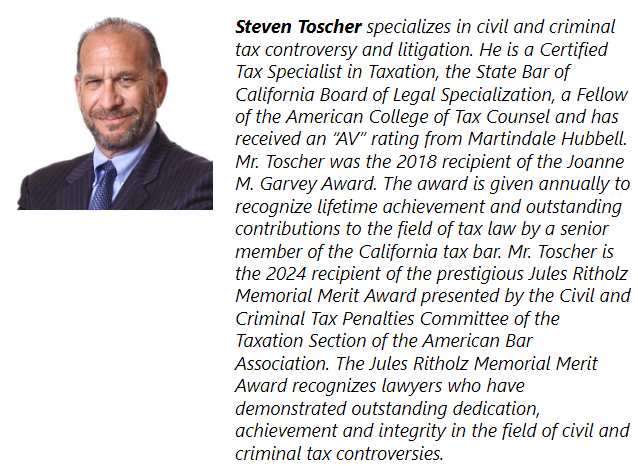
We are pleased to announce that Steven Toscher, Michel Stein, and Sandra Brown will be speaking at the upcoming Strafford webinar “Conservation Easement Tax Issues: Recent IRS Enforcement, Structuring and Defending Easement Transactions” Tuesday, October 10, 2023, 10:00 a.m. – 11:30 a.m. (PST).

The IRS has significantly increased enforcement actions for syndicated conservation easements. This crackdown on conservation easement transactions forces taxpayers, tax counsel, and advisers to identify and recognize key tax issues in structuring these transactions.

A conservation easement is a legally enforceable perpetual land preservation agreement between a landowner and either a government agency or a qualified land protection organization (such as a land trust) for the conservation of the land and its resources. Grantors within these transactions can take advantage of significant tax benefits so long as the easement meets IRS approval where there is a donation.

Typically, charitable deductions are not allowed for these transactions, but IRC Sections 170(h)(1) through (h)(5) and Treas. Reg. 1.170A-14 provide for an exception. A charitable contribution deduction is allowed for the fair market value of the conservation easement donated to certain charitable organizations, subject to a limitation on the amounts.

Limitations on the deduction lead to the setup of syndications to purchase land for the conservation easements. This results in high deductions for taxpayers and heightened scrutiny by the IRS.

The panel will review these and other crucial issues:

  • What are the key tax considerations for structuring conservation easements?
  • What are the income regulations applicable to conservation easement transactions?
  • What factors are considered by the IRS in reviewing conservation easement transactions?
  • How can taxpayers and their counsel effectively defend and litigate conservation easement tax issues?

Click Here for More Information

The Internal Revenue Service (IRS) announced (IR-2023-166, September 8, 2023) a significant shift in its tax compliance efforts, aimed at addressing the fairness of the tax system by focusing more attention on high-income earners, partnerships, large corporations, and promoters who abuse tax laws. Statements by Commissioner Danny Werfel indicate that the IRS will be using funding from the Inflation Reduction Act and leveraging improved technology, including Artificial Intelligence, to better detect tax cheating, identify emerging compliance threats, and improve case selection tools to avoid burdening taxpayers with needless no change audits. The IRS plans to increase the audit rates for wealthy individuals, partnerships, and other high earners who have seen a significant decline in audit rates over the past decade. At the same time, the audit rates for those earning less than $400,000 per year will not increase.

Key elements of this major expansion in high-income/high wealth and partnership compliance work includes:

Largest Partnerships Leveraging Artificial Intelligence (AI). In 2021, the IRS launched the first stage of its Large Partnership Compliance (LPC) program with examinations of some of the largest and most complex partnership returns in the filing population. By the end of the month, the IRS will open examinations of 75 of the largest partnerships in the U.S. that represent a cross section of industries including hedge funds, real estate investment partnerships, publicly traded partnerships, large law firms and other industries.

Greater Focus on Partnership Issues through Compliance Letters. The IRS has identified ongoing discrepancies on balance sheets involving partnerships with over $10 million in assets, which is an indicator of potential non-compliance. Taxpayers filing partnership returns are showing discrepancies in the millions of dollars between end-of-year balances compared to the beginning balances the following year. This effort will focus on high-risk large partnerships to quickly address the balance sheet discrepancy.  The IRS plans to notify around 500 partnerships though mailings in October.

Prioritization High Income Collection Cases. The IRS will intensify work on taxpayers with total positive income above $1 million that have more than $250,000 in recognized tax debt. Building off earlier successes that collected $38 million from more than 175 high-income earners, the IRS will have dozens of Revenue Officers focusing on these high-end collection cases in FY 2024. The IRS is working to expand this effort, contacting about 1,600 taxpayers in this category that owe hundreds of millions of dollars in taxes.

The IRS also announced (IR-2023-176, September 20, 2023) a plan to establish special pass-through work unit organization to help with high-income compliance efforts, which will be housed in Large Business and International (LB&I). The IRS hopes that the new unit will leverage Inflation Reduction Act funding to disrupt efforts by certain large partnerships to use pass-throughs to intentionally shield income to avoid paying the taxes they owe.  As part of a larger transformation, the IRS recently announced the opening of more than 3,700 position nationwide to help with expanded enforcement work focusing on complex partnerships, large corporations, and high-income and high-wealth individuals.

The IRS appears more ready and able than ever to address perceived non-compliance for the high-wealth individual and their related entities in efforts to close the tax gap and to make for a more equitable tax system. Taxpayers and their representations should stay informed.

UCLA Extension’s 39th Annual Tax Controversy Institute offers a platform to LB&I to showcase its latest efforts.

Interested in learning more about LB&I and its focus on high-wealth and large partnerships taxpayers, consider attending UCLA Extension’s Annual Tax Controversy Institute on October 26, 2023. Michel R. Stein will be moderating a panel during the morning session on The New Landscape in IRS Examinations – What Can We Expect in the New Tax Enforcement Environment for High Wealth Individuals and Large Partnerships, with amazing panelists:

Cliff Scherwinski – IRS Director Pass-Through Entities

Eric Cirelli – IRS Director of Field Operations, Global High Wealth

Hans Famularo – IRS Counsel (SB/SE) at Office of IRS Chief Counsel

Phil Wilson – Managing Partner, Costa Mesa Office at Marcum LLP

Michel R. Stein (Moderator)- Principal, Hochman Salkin Toscher & Perez 

UCLA Extension’s Annual Tax Controversy Conference is the preeminent conference exclusively dedicated to tax controversy and tax litigation. The conference provides an open forum for distinguished presenters and panelists to discuss, and often debate, sensitive tax practice issues with an engaged audience. For more information about the UCLA 39th Annual Tax Controversy Institute, click on this link.

« Newer Posts - Older Posts »

Categories