We are pleased to announce that Sebastian Voth along with Charles M. Ruchelman (Caplin & Drysdale) will be speaking at the upcoming Florida Tax Institute at the JW Marriott Tampa Water Street on Recent Developments in Tax Court Litigation – What You Need to Know, Thursday, February 6, 2025, 10:30 a.m. – 11:30 a.m. (EST).
Tax litigation has seen a series of changes in recent years disrupting rules that seemed beyond dispute, including whether court deadlines are jurisdictional, whether deference is still afforded to administrative regulations, and how penalties must be approved, calculated, and assessed. This panel will discuss challenges presented by recent cases, the current state of these evolving standards, and how it could impact you if you are selected for examination and cannot resolve a tax issue without litigation. What materials should you have and maintain, what mistakes should you avoid, and how do you help your trial counsel if the case is litigated?
What is the Florida Tax Institute?
The three-day Institute features programming delivered by nationally recognized speakers devoted to individual income tax, entity tax, and estate/gift tax. It is designed to be practical, informative, engaging, and innovative. The Institute draws attorneys, accountants, trust officers, estate planners, insurance and financial planners, appraisers, and planned giving professionals from across Florida and the United States. The Institute continues to build on the exceptional success of the previous institutes.
We are pleased to announce that the USC Gould School of Law 2025 Tax Institute was a great success this year carrying on a long tradition in Los Angeles. We were fortunate to have our lawyers (including Jonathan Kalinski not pictured) lead great discussions on some of the most important issues in tax controversy.
Thank you to all the panel members.
“It was my honor to moderate a panel on Employee Retention Credits with my fellow tax experts, Dan Mayo and Philip Wilson, at the USC Gould School of Law 2025 Tax Institute.“
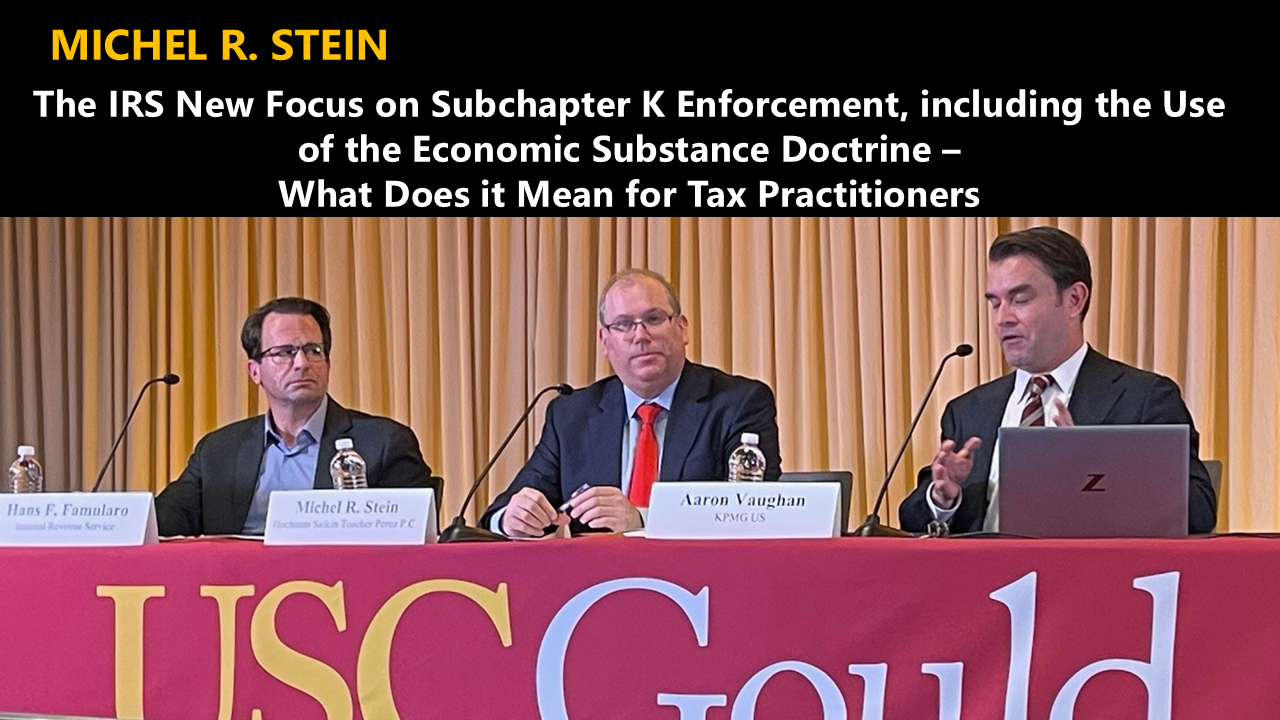
“A shout out to our expert panel for an informative and valuable discussion at the USC Tax Institute on the topic of The IRS New Focus on Subchapter K Enforcement, including the Use of the Economic Substance Doctrine – What Does it Mean for Tax Practitioners. The panel moderated by Michel R. Stein, who joined with 𝗛𝗮𝗻𝘀 𝗙𝗮𝗺𝘂𝗹𝗮𝗿𝗼, IRS Special Counsel and Aaron Vaughan, Managing Director of KPMP, to provide an in-depth perspective on partnership enforcement , the new IRS Basis Shifting Regulations, and the Economic Substance Doctrine.”
“The speakers on this panel, which included an experienced IRS lawyer, reaffirmed that the IRS cares about fraud and will continue to pursue civil and criminal fraud cases.”
Sandra R. Brown is a Principal of the law firm Hochman Salkin Toscher Perez P.C., where she specializes in criminal tax investigations, grand jury matters, litigation and appeals, as well as representing and advising taxpayers involved in complex and sophisticated civil tax controversies, including sensitive-issue audits and administrative appeals, as well as civil litigation. Prior to joining the firm, Ms. Brown served as the Acting United States Attorney, First Assistant United States Attorney; and Chief of the Tax Division in the Office of the U.S. Attorney, Central District of California.
During her 27 years as a trial lawyer, she personally handled over 2,000 tax cases on behalf of the United States. During her tenure with the government, Ms. Brown received the Internal Revenue Service Criminal Investigation Chief’s Award and the IRS’s Mitchell Rogovin National Outstanding Support of the Office of Chief Counsel Award, the highest recognitions awarded by the IRS to non-IRS employees.
Ms. Brown obtained her LL.M. in Taxation from the University of Denver, is a fellow of the American College of Tax Counsel, Vice-Chair of the ABA’s Section of Taxation’s Criminal and Civil Tax Penalties Committee, Co-Chair of the UCLA Tax Controversy Institute, Co-Chair of the ABA Criminal Tax Fraud and Tax Controversy Conference, an ABA Loretta Collins Argrett Fellowship Mentor, and is a frequent lecturer and author on tax controversy topics, including international compliance matters. Ms. Brown has been recognized as one of California’s top 100 leading women lawyers and most recently, the recipient of USD School of Law’s Richard Carpenter Excellence in Tax Award and honored at the California Lawyers Association Tax Bar and Tax Policy 2024 Toast to Women in Tax.
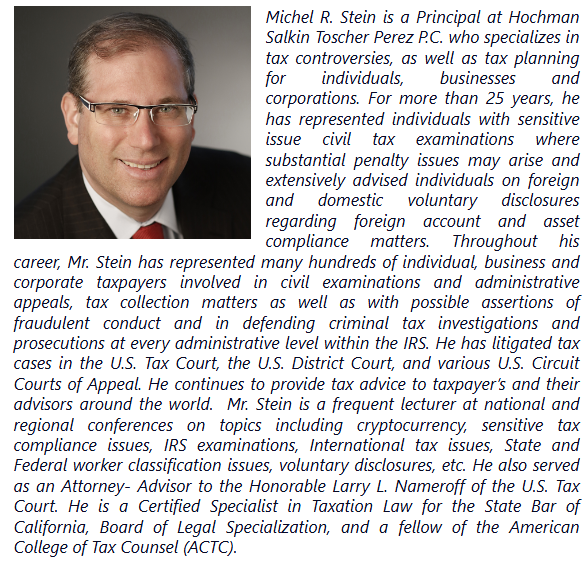
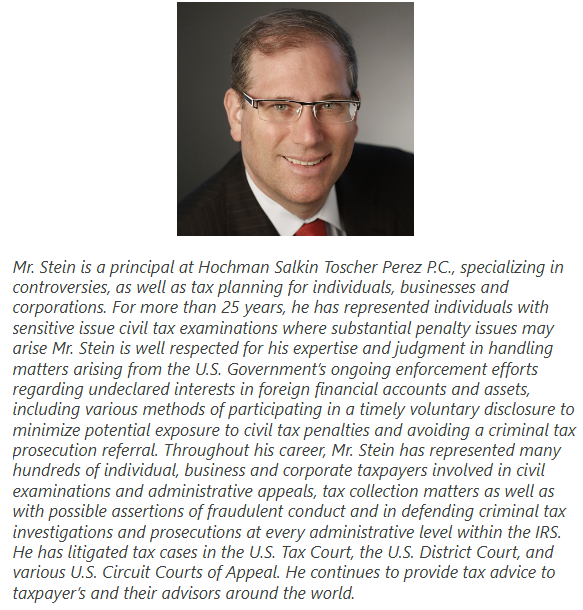
Michel R. Stein is a Principal at Hochman Salkin Toscher Perez P.C., specializing in tax controversies, as well as tax planning for individuals, businesses and corporations. For more than 25 years, he has represented individuals with sensitive issue civil and criminal tax matters where substantial penalty issues may arise, and extensively advised individuals on foreign and domestic voluntary disclosures regarding foreign account and asset compliance tax matters. Mr. Stein is a frequent lecturer at national and regional conferences on topics, including Global High Wealth examinations, cryptocurrency, sensitive tax compliance matters, IRS examinations, International tax issues and state and federal residency and worker classification matters.
Evan Davis has been a Principal at Hochman Salkin Toscher Perez P.C. since November 2016. He spent 7.5 years as a DOJ Tax civil litigator and then 11 years as an AUSA in the Office of the U.S. Attorney (C.D. Cal), including 3 years handling civil and criminal tax cases and 8 years as a white-collar prosecutor handling tax and other fraud cases from investigation through jury trial and appeal. As an AUSA, he served as the Bankruptcy Fraud coordinator, Financial Institution Fraud coordinator, and Securities Fraud coordinator. Mr. Davis handles federal and state criminal and civil tax investigations/exams, white-collar defense, cryptocurrency clients, and civil and criminal appellate matters including having litigated the In re Grand Jury attorney-client privilege matter before the US Supreme Court in 2023.
We are pleased to announce that Sebastian Vothwill be speaking at the upcoming Beverly Hills Bar Association webinar on Understanding the Economic Substance Doctrinewebinar, Tuesday, February 4, 2025, 12:30 p.m. – 1:30 p.m. (PST).
This program will be an informative session exploring the Economic Substance Doctrine—a critical principle in tax law designed to prevent tax avoidance through transactions that serve no economic purpose other than tax savings.
This program will provide an in-depth analysis of the doctrine’s evolution, practical applications, and a look at the recent cases litigated in Tax Court and beyond.
The key topics include the origins and statutory codification of the Economic Substance Doctrine under IRC §7701(o) and how courts evaluate transactions for economic substance.
Mr. Vothis a Principal at Hochman Salkin Toscher Perez P.C., specializing in tax investigations, litigation and appeals, and complex tax matters. Prior to entering private practice, Mr. Voth served for 15 years at the Internal Revenue Service including most recently as a Special Trial Attorney with the IRS Office of Chief Counsel’s Strategic Litigation Division leading trial teams in all phases of litigation before the Tax Court. During his tenure with the IRS, Mr. Voth served on the leadership team of the nationwide IRS Counsel mentoring program and mentored numerous IRS attorneys. He is the recipient of two Lucite Awards for significant Tax Court opinions and received a 2024 Special Act Award (Strategic Litigation), the 2023 Nationwide Innovator of the Year (LB&I), the 2022 Nationwide Special Trial Attorney of the Year (SB/SE), the 2017 U.S. Department of the Treasury Outstanding Litigator and the 2017 Nationwide Attorney of the Year (SB/SE). As a Special Trial Attorney, Mr. Voth also lectured on civil tax fraud, litigation skills, including the Federal Rules of Evidence, best practices for preparing cases for trial, and working with expert witnesses.
We are pleased to announce that Michel R. Stein along with Charlotte Wall (Spott, Lucey & Wall, Inc. CPAs) will be speaking at the upcoming CalCPA Tax Issues in Divorce Mini-Conference on When Divorce Crosses International Borders webinar, Thursday, January 30, 2025, 1:45 p.m. – 2:45 p.m. (PST).
Michel and Charlotte will explore critical tax considerations that arise when cases span multiple countries. These international compliance elements bring unique financial and legal challenges that need to be addressed to ensure your clients get the best possible outcome.
What is the CalCPA Tax Issues in Divorce Mini Conference?
It is a conference to help clients, and their tax professionals, navigate divorce while keeping a keen eye on long-term tax implications. Don’t miss this half-day conference packed with insights from top experts! The panels will dive into estates, trusts, and family law essentials, analyze business expense deductions through recent case studies, and cover the latest tech developments. This event is a must for anyone handling the financial intricacies of divorce.
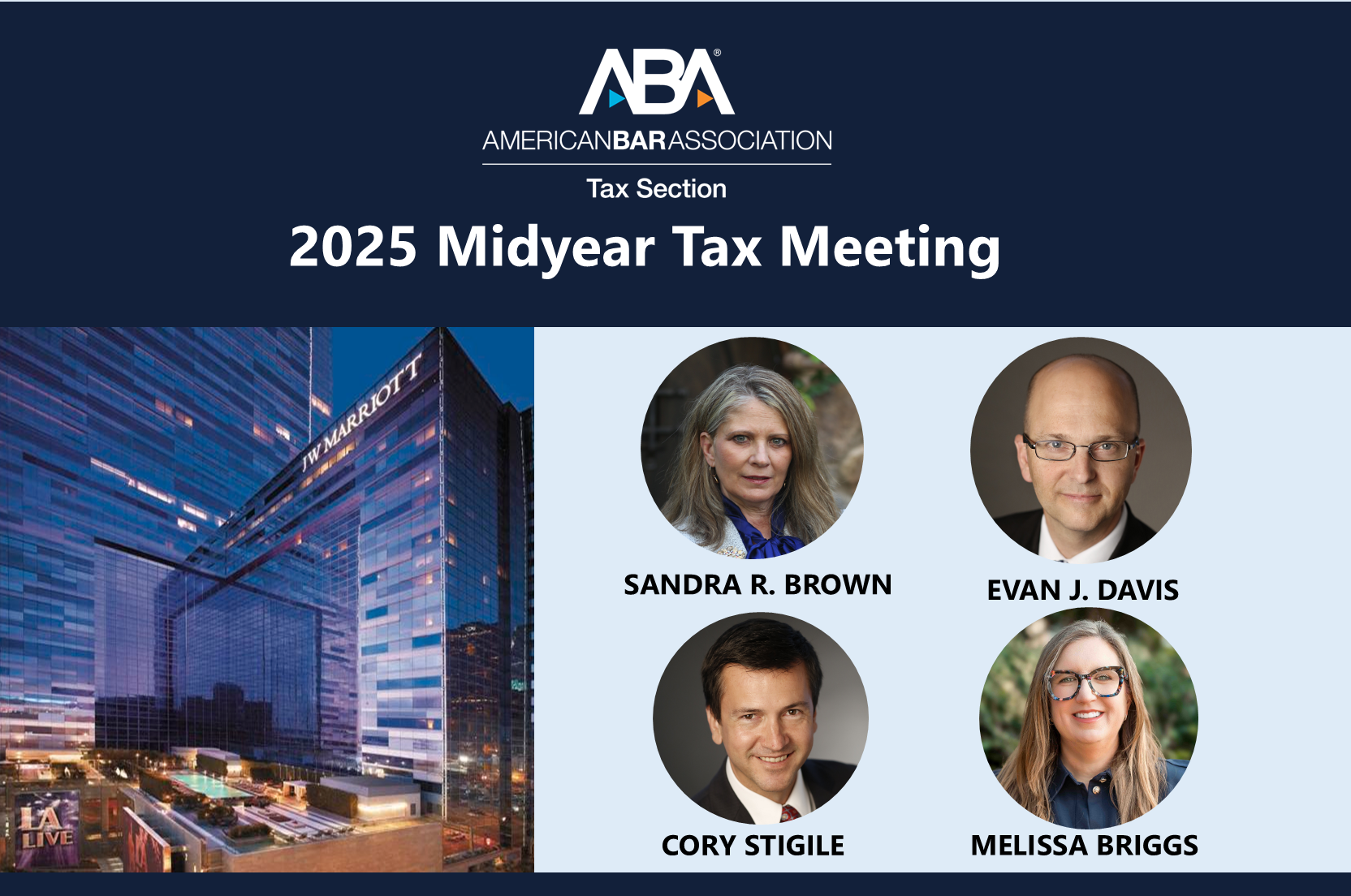
We are pleased to announce that four of our Principals will be presenting at the ABA 2025 Midyear Tax Meeting which will take place on February 19-21 at the JW Marriott Los Angeles L.A. LIVE.
Learn from and meet with the country’s leading tax attorneys and government officials, discussing the latest federal, state, and local tax policies and more, including our firm presentations.
Sandra R. Brown IRS Criminal Investigations – Administrative Summonses and Grand Jury Subpoenas February 20, 2025: 4:25 pm
Evan Davis How to Navigate Minefields When Representing a TaxpayerDuring Tax Litigation February 21, 2025: 9:15 am
Cory Stigile Ethics in Representation – How to Counsel Taxpayers February 20, 2025: 10:00 am
Melissa Briggs Hot Topics and Common Pitfalls in Refund Litigation February 21, 2025: 8:30 am
This conference is by far one of the best programs in the country for both experienced tax practitioners and those looking to gain more experience in their tax practices.
Registration information and the full program can be found here.
We look forward to seeing you.
Sandra R. Brown is a Principal of the law firm Hochman Salkin Toscher Perez P.C., where she specializes in criminal tax investigations, grand jury matters, litigation and appeals, as well as representing and advising taxpayers involved in complex and sophisticated civil tax controversies, including sensitive-issue audits and administrative appeals, as well as civil litigation. Prior to joining the firm, Ms. Brown served as the Acting United States Attorney, First Assistant United States Attorney; and Chief of the Tax Division in the Office of the U.S. Attorney, Central District of California.
During her 27 years as a trial lawyer, she personally handled over 2,000 tax cases on behalf of the United States. During her tenure with the government, Ms. Brown received the Internal Revenue Service Criminal Investigation Chief’s Award and the IRS’s Mitchell Rogovin National Outstanding Support of the Office of Chief Counsel Award, the highest recognitions awarded by the IRS to non-IRS employees.
Ms. Brown obtained her LL.M. in Taxation from the University of Denver, is a fellow of the American College of Tax Counsel, Vice-Chair of the ABA’s Section of Taxation’s Criminal and Civil Tax Penalties Committee, Co-Chair of the UCLA Tax Controversy Institute, Co-Chair of the ABA Criminal Tax Fraud and Tax Controversy Conference, an ABA Loretta Collins Argrett Fellowship Mentor, and is a frequent lecturer and author on tax controversy topics, including international compliance matters. Ms. Brown has been recognized as one of California’s top 100 leading women lawyers and most recently, the recipient of USD School of Law’s Richard Carpenter Excellence in Tax Award and honored at the California Lawyers Association Tax Bar and Tax Policy 2024 Toast to Women in Tax.
Evan Davis has been a Principal at Hochman Salkin Toscher Perez P.C. since November 2016. He spent 7.5 years as a DOJ Tax civil litigator and then 11 years as an AUSA in the Office of the U.S. Attorney (C.D. Cal), including 3 years handling civil and criminal tax cases and 8 years as a white-collar prosecutor handling tax and other fraud cases from investigation through jury trial and appeal. As an AUSA, he served as the Bankruptcy Fraud coordinator, Financial Institution Fraud coordinator, and Securities Fraud coordinator. Mr. Davis handles federal and state criminal and civil tax investigations/exams, white-collar defense, cryptocurrency clients, and civil and criminal appellate matters including having litigated the In re Grand Jury attorney-client privilege matter before the US Supreme Court in 2023.
Cory Stigile is a Principal at Hochman Salkin Toscher Perez P.C., who specializes in tax controversies as well as business and international tax. His representation includes federal and state tax controversy matters, including sensitive tax-related examinations and investigations for individuals, partnerships, limited liability companies, and corporations. His practice also includes complex civil tax examinations, administrative appeals and tax collection proceedings (where he is widely respected for achieving meaningful resolutions of difficult tax collection issues). He has litigated cases in the U.S. Tax Court, the U.S. District Court, the Court of Federal Claims and the 9th Circuit Court of Appeals.
Mr. Stigile is a Certified Specialist, Taxation Law, The State Bar of California, Board of Legal Specialization.
Mr. Stigile is also a CPA licensed in California. He is an active volunteer with CalCPA and the AICPA, and is the President of PADI Foundation.
Melissa Briggs is a Principal of the law firm Hochman Salkin Toscher Perez P.C., where she specializes in tax investigations, litigation and civil tax matters. Ms. Briggs has over 20 years of litigation experience in private, nonprofit, and government practice. Ms. Briggs served a combined 16 years as an appellate attorney for the U.S. Department of Justice, Tax Division Appellate Section and, most recently, as an Assistant United States Attorney with the United States Attorney’s Office for the Central District of California’s Tax Division.
During her tenure with the U.S Attorney’s Office, Ms. Briggs handled all aspects of litigation of affirmative and defensive civil tax cases in the United States District Court for the Central District of California, United States Bankruptcy Court for the Central District of California, and California state courts. She served as a Federal Women’s Special Emphasis Programs Manager coordinating office-wide events including panel discussions and networking events. Ms. Briggs is the recipient of the U.S. Department of Justice, Tax Division, Outstanding Attorney Award and the Alabama State Bar Pro Bono Award.
We are pleased to announce that Michel R. Stein along with Charles M. Ruchelman (Caplin & Drysdale) and Fred Murray (Office of Chief Counsel, Internal Revenue Service)will be speaking at the upcoming Florida Tax Institute at the JW Marriott Tampa Water Street on Recent Developments in Tax Court Litigation – What You Need to Know webinar, Thursday, February 6, 2025, 10:30 a.m. – 11:30 a.m. (EST).
Tax litigation has seen a series of changes in recent years disrupting rules that seemed beyond dispute, including whether court deadlines are jurisdictional, whether deference is still afforded to administrative regulations, and how penalties must be approved, calculated, and assessed. This panel will discuss challenges presented by recent cases, the current state of these evolving standards, and how it could impact you if you are selected for examination and cannot resolve a tax issue without litigation. What materials should you have and maintain, what mistakes should you avoid, and how do you help your trial counsel if the case is litigated?
What is the Florida Tax Institute?
The three-day Institute features programming delivered by nationally recognized speakers devoted to individual income tax, entity tax, and estate/gift tax. It is designed to be practical, informative, engaging, and innovative. The Institute draws attorneys, accountants, trust officers, estate planners, insurance and financial planners, appraisers, and planned giving professionals from across Florida and the United States. The Institute continues to build on the exceptional success of the previous institutes.
We previously wrote about the IRS’s campaign under its Large Business & International (LB&I) Division: The Business Aircraft Campaign (the “BAC” or “aircraft campaign”). The purpose of this article is to further delve into some nuances associated with the aircraft campaign while also considering likely tax implications for high-income individuals who have claimed aircraft-related expenses.
The Internal Revenue Service (IRS) recently issued Notice 2025-7 on December 31, 2024, providing temporary relief for taxpayers who sell, dispose of, or transfer digital assets held in the custody of brokers. This notice addresses challenges taxpayers face in adequately identifying specific units of digital assets during sales, dispositions, or transfers, particularly when brokers lack the necessary technology to process such identifications. The Notice applies to sales, dispositions, or transfers that occur between January 1 and December 31, 2025.
On December 23, 2024, the U.S. District Court for the Southern District of New York authorized the IRS to issue “John Doe” summonses targeting individuals who may have used the services of Trident Trust Group (“Trident”) or related entities to conceal foreign assets or income. This order marks the continued efforts in the IRS’s campaign to uncover offshore tax evasion and demonstrates its aggressive push to enforce compliance by U.S. taxpayers who used foreign accounts and entities to hide income.
In a recent Tax Notes article by Mary Katherine Browne (published December 31, 2024), the spotlight is on the cryptocurrency industry’s legal challenge to the IRS’s newly finalized decentralized finance (DeFi) broker reporting regulations. The article, titled “Crypto Industry Seeks to Strike Down DeFi Reporting Regs,” delves into the case of Blockchain Association v. IRS, where three DeFi advocacy groups allege that the regulations constitute an unlawful overreach by the government.
The final regulations, issued on December 27, 2024, expand the definition of a broker under Section 6045 to include front-end service providers in DeFi transactions. Critics argue that this interpretation imposes burdensome compliance obligations that are incompatible with blockchain technology’s decentralized nature.
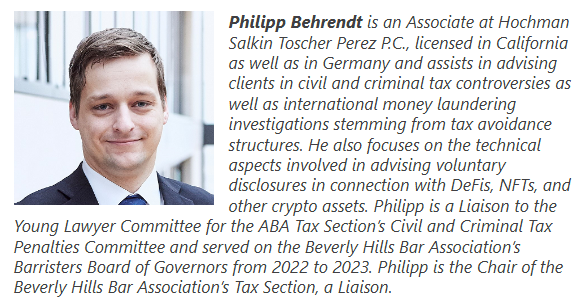
Among the legal experts quoted in the article, Philipp Behrendt of Hochman Salkin Toscher Perez P.C. offered a critical perspective on the regulations’ implications. Behrendt described the IRS’s decision to classify front-end services as brokers as “surprising and bold,” noting that it deviates from traditional brokerage concepts.
“By attempting to impose a centralized reporting framework on inherently decentralized systems, the regulation undermines the core innovation of DeFi: the elimination of intermediaries,” Behrendt explained. He further warned that the rule threatens the viability of U.S.-based DeFi platforms, potentially forcing them offshore or out of business altogether.
Behrendt also pointed out the privacy concerns raised by the new rules. “Connecting personal identities to transactions on the blockchain, which are pseudonymous, would reveal vast troves of personal information to the world, including whom people bought digital assets from and sold them to,” he said.
The Tax Notes article highlights how the lawsuit challenges the regulations on several grounds, including statutory overreach and violations of the Fourth and Fifth Amendments. Behrendt emphasized that the recent Supreme Court decision in Loper Bright Enterprises Inc. v. Raimondo bolsters the plaintiffs’ case, as it curtails deference to regulatory interpretations of ambiguous statutes.
Behrendt finds it somewhat surprising that the lawsuit acknowledges that cryptocurrencies such as Bitcoin are “digital representations of value.” “This is somewhat surprising, given that the statutory language defining ‘digital assets’ as representations of value is not entirely clear. Cryptocurrencies, particularly non-stablecoins, usually do not represent anything; they have intrinsic value but do not inherently ‘represent’ value,” Behrendt said.
As legal battles shape the future of DeFi and digital asset regulation in the United States, the field of digital asset taxation is set to undergo further transformation under the new administration and ongoing legal challenges.
Legal Disclaimer. This Report only provides general information about the law and does not, under any circumstances, constitute legal advice in any manner. The facts of each situation are unique and you should not act or refrain from acting in any manner based on any information contained or referenced in this Report at any time without first obtaining the advice of competent professional legal counsel. This site contains links to third-party internet sites. We are not responsible in any manner for, and make no representations or endorsements of any kind whatsoever with respect to, any third-party internet sites or with respect to any information, products or services that such internet sites might offer or provide.










 TAXLITIGATOR - Tax Controversy (Civil & Criminal) Report