We are pleased to announce that Michel R. Stein, Evan Davis and Philipp Behrendt will be speaking at the upcoming CalCPA Cryptocurrency Compliance webinar, Tuesday, August 13, 2024, 9:00 a.m. – 10:30 a.m. (PST).

The program will provide tax advisers and compliance professionals with a practical look at IRS guidance for calculating and reporting income and gain on cryptocurrency (e.g., Bitcoin) transactions. We’ll discuss the IRS’s latest positions on cryptocurrency, analyze IRS efforts to increase compliance and define proper reporting and the tax treatment for convertible virtual currency and cryptocurrency, stablecoins, as well as NFTs. We will address recently released Broker Reporting Regulations, the latest released IRS Guidance, the recent IRS enforcement initiatives to identify digital asset activity, how the IRS enforcement strategy fits into the voluntary disclosure practice, and the risks of criminal prosecution related to unreported and improperly reported cryptocurrency transactions. 

Click Here for More Information

For more information, please contact Michel R. Stein at stein@taxlitigator.com

For more information, please contact Evan Davis at davis@taxlitigator.com

For more information please contact Philipp Behrendt at behrendt@taxlitigator.com

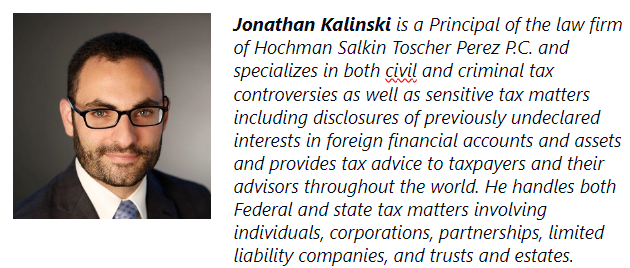
We are pleased to announce that Jonathan Kalinski along with Ani Galyan (Galyan Law) will be speaking at an upcoming Strafford webinar on Tax Implications of Reclassifying Cannabis From a Schedule I to a Schedule III Drug, Tuesday, July 30, 2024, 10:00 a.m. – 11:30 a.m. (PST).

This webinar will provide tax professionals guidance on key tax implications of rescheduling cannabis from a Schedule I to a Schedule III drug. They will discuss the recent move by the Department of Justice to reclassify cannabis as a less harmful Schedule III drug under the Controlled Substances Act, its impact on federal and state-level taxation, Section 280E, and tax planning methods and reporting requirements for cannabis businesses under current tax law.

Click Here for More Information

For more information, please contact Jonathan Kalinski at kalinski@taxlitigator.com

In the ever-evolving financial technology landscape, virtual currencies, now more broadly termed “digital assets,” have emerged as a significant challenge for tax administration. The Treasury Inspector General for Tax Administration (TIGTA) recently released a comprehensive report titled “Virtual Currency Tax Compliance Enforcement Can Be Improved” (Report Number: 2024-300-030, dated July 10, 2024).  This report provides a critical examination of the Internal Revenue Service’s efforts to address tax compliance in the realm of digital assets.  As tax professionals, it is incumbent upon us to thoroughly understand and analyze these findings to better serve our clients and navigate the complex intersection of tax law and emerging financial technologies.

Click Here for Full Article

For more information, please contact Steven Toscher at toscher@taxlitigator.com

For more information, please contact Philipp Behrendt at behrendt@taxlitigator.com

We are pleased to announce that Philipp Behrendt will be speaking on two  upcoming Beverly Hills Bar Association programs focused on the Review of New IRS Regulations on Digital Asset Transaction Reporting for Brokers, which will address the following topics:

This program will focus on the application of the final regulations, guiding attorneys who advise brokers and taxpayers on what to expect from broker reporting requirements. It will cover the specific obligations for brokers, including filing information returns and furnishing payee statements. This session will explain the processes involved, specifying who is required to report, the types of transactions covered, and the timelines for compliance. Attorneys will gain crucial insights into advising their clients on the practical aspects of broker reporting under the final regulations.

This panel will examine the broader implications of the final regulations, particularly in relation to the computation of gross proceeds and basis, guiding attorneys on these critical issues. This session will discuss how the new reporting requirements influence the calculation of these financial metrics, which are essential for accurate tax reporting and compliance. Experts will explore the methodologies for determining gross proceeds and basis in digital asset transactions, highlighting the challenges and opportunities presented by the regulatory changes. Attorneys will gain valuable insights into advising their clients on these complex regulatory changes.

Click Here for More Information

For more information please contact Philipp Behrendt at behrendt@taxlitigator.com.

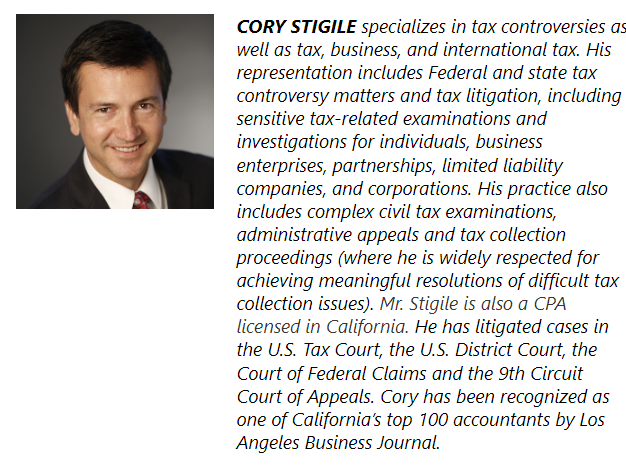
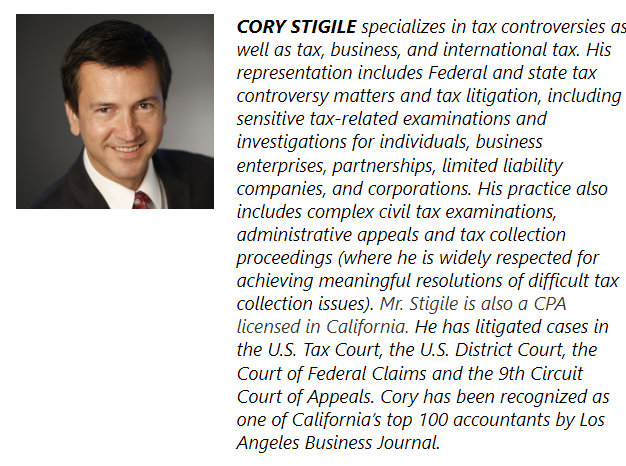
We are pleased to announce that Cory Stigile and Philipp Behrendt will be speaking at the upcoming CalCPA 2024 Annual Income Tax Seminar, Friday, July 26, 2024, 8:00 a.m. – 1:45 p.m. (PST) on the following topics:

Cory Stigile
New Enforcement Considerations

This session will cover the impacts of non-compliance, responding to IRS subpoenas, and recent penalty changes. Explore the implications of 6751(b), updates on ERC issues, and the process of participating in voluntary disclosure. Learn about amending tax returns, new provisions in H.R. 7024, and best practices for tax preparers to stay compliant and proactive. 

Philipp Behrendt
Practice Tips for Information Reporting

Stay ahead with the latest updates on 1099-K and 1099-DA (digital asset) forms. Learn why 1099s may not appear accurate and how to reconcile discrepancies, address 1099-K TPSO status, and utilize IRIS to avoid CP2000 notices. Expand your knowledge and enhance your practice with practical tips from industry experts.

Click Here for More Information

We are pleased to announce that Sandra R. Brown will be receiving the prestigious Richard Carpenter Excellence in Tax Award from the USD School of Law – RJS LAW Tax Controversy Institute. The Award is being presented at the 9th Annual USD School of Law – RJS LAW Tax Institute taking place July 19th in San Diego, California.

This award is given to an individual who exemplifies honesty, integrity, ethics, and compassion throughout their careers in the field of tax controversy and has demonstrated outstanding dedication and expertise while representing taxpayers before the federal and state governments.

Sandra is a Principal of the law firm Hochman Salkin Toscher Perez P.C., where she specializes in criminal tax matters as well as representing and advising taxpayers involved in complex and sophisticated civil tax controversies, including sensitive-issue audits, administrative appeals, and litigation in federal, state and tax court.

Prior to entering private practice, Sandra served as the Acting United States Attorney, First Assistant United States Attorney, and Chief of the Tax Division in the Office of the U.S. Attorney, Central District of California. During her 27 years as a trial lawyer, she personally handled over 2,000 tax cases on behalf of the United States before the United States District Court, the Ninth Circuit Court of Appeals, the United States Bankruptcy Court, the United States Bankruptcy Appellate Panel, and the California Superior Court. Included in those cases are two U.S. Supreme Court decisions and a multitude of published 9th Circuit decisions.

Sandra obtained her LL.M. in Taxation from the University of Denver, is a fellow of the American College of Tax Counsel, Vice-Chair of the ABA’s Section of Taxation’s Criminal and Civil Tax Penalties Committee, Co-Chair of the UCLA Tax Controversy Institute, and is a frequent lecturer and author on tax controversy topics, including international compliance matters. Sandra has been recognized as one of California’s top 100 leading women lawyers and Chambers for her excellence in serving her clients nationwide and internationally. 

Click Here for More Information

On June 20, 2024, the Supreme Court issued its decision in Moore v. United States, 603 U.S. ___, upholding the constitutionality of the Mandatory Repatriation Tax (“MRT”). While it was pending, the case was the subject of more commentary than any tax case in recent memory. Many commentators were in a twitter that a ruling in favor of the Moores would undermine many of the income tax provisions of the Internal Revenue Code (“IRC”). This was because if the Court held that to be taxable, income must be “realized” by the taxpayer, it would superimpose on the IRC the requirement that a taxpayer had to have actually receive the funds. Such a requirement would call into question the constitutionality of Subchapter K (taxation of partnerships), Subchapter S (taxation of S corporations) and a number of other provisions of the IRC. These fears proved unfounded.

Click Here for Full Article

On July 1, the Supreme Court issued its opinion in Corner Post, Inc. v. Federal Reserve Board, 603 U.S. ____ (2024), its second major decision in four days that expanded the ability of aggrieved parties to challenge federal agency regulations, including tax regulations. Under 28 U.S.C. §2401(a), a person has six years within which to file a civil suit against the United States Government. The issue in Corner Post, Inc., was whether a person who claims injury due to final agency action has six years from the date of injury or six years from the date of final agency action within which to file a lawsuit.

Click Here for Full Article

Forty years ago, the Supreme Court in Chevron U.S.A., Inc. v. Natural Resources Defense Council, Inc., articulated a new test for determining the deference to be given to an agency’s interpretation of a statute. The Chevron Doctrine, as it came to be known, became a fixture of federal jurisprudence. In Mayo Foundation v. United States, the Court held that Chevron’s deferential standard applied to tax regulations.

Click Here for Full Article

We are pleased to announce that Edward M. Robbins, Jr., Robert S. Horwitz and Michael Greenwade will be speaking at the upcoming Strafford webinar “Foreign Information Return Penalties After Farhy: Impact of DC Circuit Court Decision” Thursday, July 18, 2024, 10:00 a.m. – 11:50 a.m. (PST).

In Farhy v. Commissioner 160 T.C. No. 6 (T.C. Apr. 3, 2023), the Tax Court ruled that the IRS did not have the authority to assess and collect penalties under IRC Section 6038(b) for failure to file Forms 5471. On appeal, the D.C. Circuit Court overturned the Tax Court decision. This case has ramifications for other forms, including Forms 5472, 8858, 8938, 926, and perhaps even Form 3520.

International tax advisers need to know how the IRS will likely respond to this decision, how this decision impacts taxpayers in other circuits, and the impact of a potential appeal to the U.S. Supreme Court. This webinar will examine the impact of Farhy v. Commissioner on foreign information return reporting penalties and detail the actions international tax practitioners need to take in light of this case, including the recent D.C. Circuit Court ruling. 

Click Here for More Information

« Newer Posts - Older Posts »

Categories