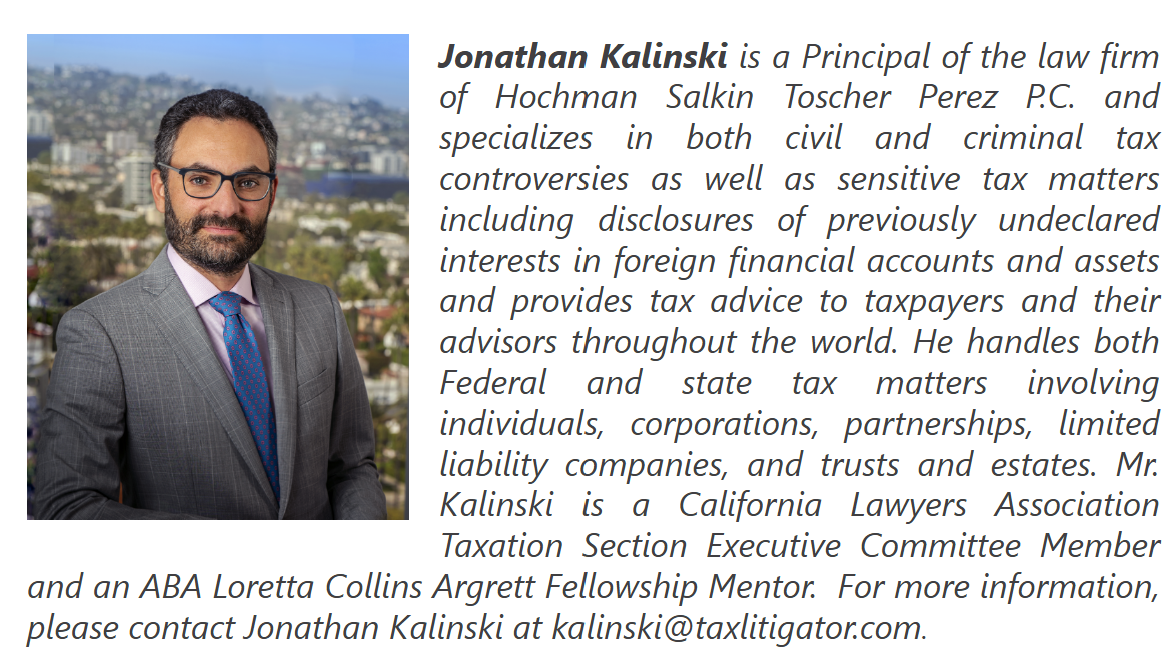
We are pleased to announce that Jonathan Kalinski and Philipp Behrendt along with Jordan Bass (Taxing Cryptocurrency)will be speaking at the upcoming Strafford Taxation of Digital Asset Transactions Under Current Tax Law webinar, Thursday, April 3, 2025, 10:00 a.m. – 11:30 a.m. (PST).
This webinar will provide tax counsel and advisers with a detailed analysis of the taxation of digital asset transactions under current tax law. The panel will discuss the impact of applicable IRS tax rules and recent regulations, sourcing of income rules and challenges, issues presented by applicable international tax rules under the Internal Revenue Code, and other vital items impacting taxpayers engaging in digital asset transactions.
We are pleased to announce that Steven Toscher and Michel R. Stein along with William J. Curtis (Polsinelli) will be speaking at the upcoming Strafford IRS Final Regulations for Syndicated Conservation Easements webinar, Thursday, March 27, 2025, 10:00 a.m. – 11:30 a.m. (PST).
This course will provide tax counsel and advisers guidance on critical tax issues concerning conservation easement transactions in light of IRS final regulations. The panel will discuss critical elements of the IRS final regulations and the impact on conservation easement transactions, address IRS assessments and audits, and offer techniques for defending conservation easement transactions.
On Oct. 8, 2024, the IRS issued final regulations for conservation easement structures and related transactions. The final regulations solidify the IRS’ continued focus on enforcement actions for syndicated conservation easements. Taxpayers, tax counsel, and advisers must identify and recognize key tax issues stemming from the final regulations in structuring these transactions and defending against IRS examination.
The final regulations provide that syndicated conservation easements are listed transactions for disclosure purposes, clarify the definition of “conservation easements” and “participants,” and categorize syndicated conservation easements and substantially similar transactions into separate classes of abusive transactions, along with other significant provisions.
The panel will discuss key elements of the IRS final regulations, structuring conservation easement transactions, and minimizing IRS assessments and audits, as well as offers techniques for defending conservation easement transactions.
We are pleased to announce that Sebastian Voth will speak before the Glendale Estate Planning Council on Monday, March 18, 2025. His presentation will delve into “audit stage” type issues to consider at the estate planning level, including privilege issues, IRS summons interviews, communications with experts, and preparing for potential Tax Court litigation. Understanding your client’s potential and varied tax authority audiences from the audit stage through trial is essential to preserve your client’s best interests and potential tax mitigation strategies.
Sebastian Voth is a Principal at Hochman Salkin Toscher Perez P.C., specializing in tax investigations, litigation and appeals, and complex tax matters. Prior to entering private practice, Mr. Voth served for 15 years at the Internal Revenue Service including most recently as a Special Trial Attorney with the IRS Office of Chief Counsel’s Strategic Litigation Division leading trial teams in all phases of litigation before the Tax Court. During his tenure with the IRS, Mr. Voth served on the leadership team of the nationwide IRS Counsel mentoring program and mentored numerous IRS attorneys. He is the recipient of two Lucite Awards for significant Tax Court opinions and received a 2024 Special Act Award (Strategic Litigation), the 2023 Nationwide Innovator of the Year (LB&I), the 2022 Nationwide Special Trial Attorney of the Year (SB/SE), the 2017 U.S. Department of the Treasury Outstanding Litigator and the 2017 Nationwide Attorney of the Year (SB/SE). As a Special Trial Attorney, Mr. Voth also lectured on civil tax fraud, litigation skills, including the Federal Rules of Evidence, best practices for preparing cases for trial, and working with expert witnesses.
We are pleased to announce that Cory Stigile had been elected as Fellow of the American College of Tax Counsel. Cory joins seven other members of our firm who are Fellows of the most prestigious group of tax lawyers in the United States.
As noted by the President of ACTC, “The new Fellows bring a range of tax practice diversity to the important work of the College in advancing sound tax policy and effective tax administration.”
Cory Stigile is a Principal at Hochman Salkin Toscher Perez P.C., who specializes in tax controversies as well as business and international tax. His representation includes federal and state tax controversy matters, including sensitive tax-related examinations and investigations for individuals, partnerships, limited liability companies, and corporations. His practice also includes complex civil tax examinations, administrative appeals and tax collection proceedings (where he is widely respected for achieving meaningful resolutions of difficult tax collection issues). He has litigated cases in the U.S. Tax Court, the U.S. District Court, the Court of Federal Claims and the 9th Circuit Court of Appeals.
Mr. Stigile is a Certified Specialist, Taxation Law, The State Bar of California, Board of Legal Specialization.
Mr. Stigile is also a CPA licensed in California. He is an active volunteer with CalCPA and the AICPA, and is the President of PADI Foundation.
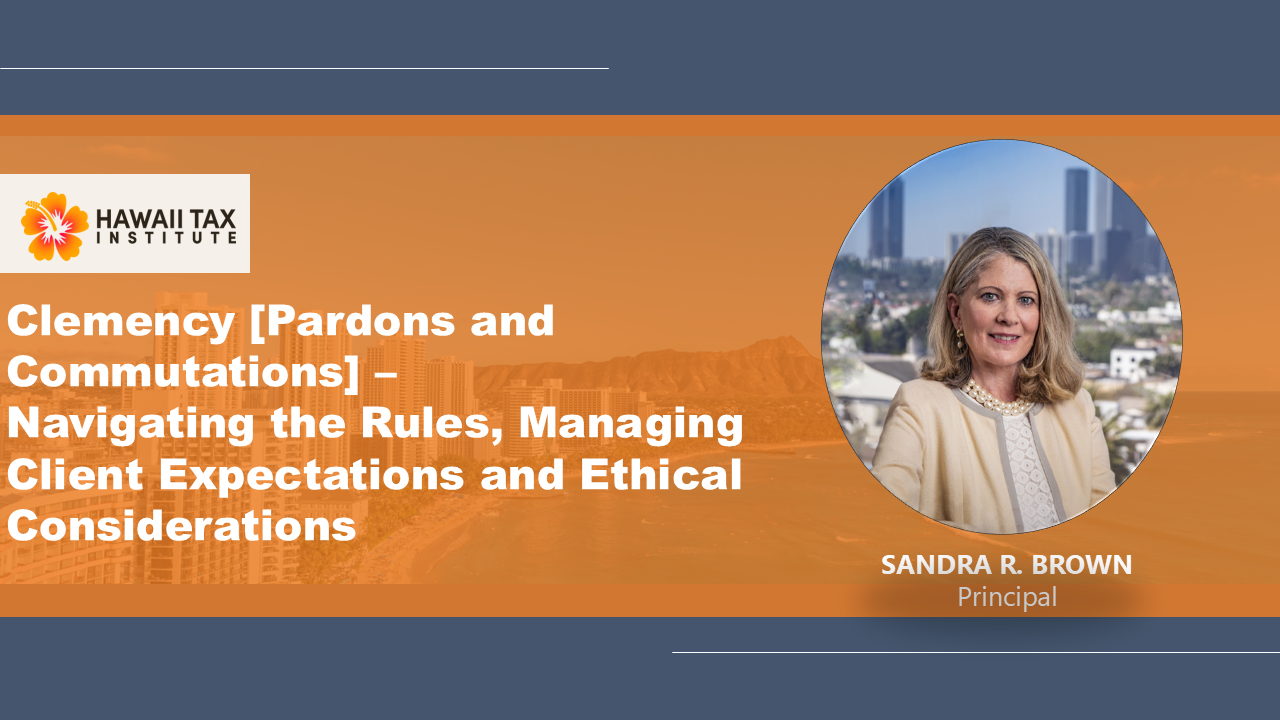
We are pleased to announce that Sandra R. Brown along with Caroline Ciraolo (Kostelanetz LLP), Maisha Horton (IRS Criminal Investigations Division), Matthew Mueller (Fogarty Mueller Harris, PLLC) and Rod Rosenstein (King & Spalding) will be speaking on The Long and Winding Road From Civil Fraud Referral to Criminal Tax Indictment at the upcoming ABA Criminal Justice Section 40th White Collar Crime Institute being held at the Hyatt Regency, Miami, Florida, Wednesday, March 5, 2025, 10:30 a.m. (EST).
This program will explore the challenges and strategies when dealing with parallel investigations involving the IRS and federal tax inquiries by different state and/or federal government entities, including issues that arise when government coordination may result in a determination of a “joint” rather than parallel matter.
Sandra R. Brown is a Principal of the law firm Hochman Salkin Toscher Perez P.C., where she specializes in criminal tax investigations, grand jury matters, litigation and appeals, as well as representing and advising taxpayers involved in complex and sophisticated civil tax controversies, including sensitive-issue audits and administrative appeals, as well as civil litigation. Prior to joining the firm, Ms. Brown served as the Acting United States Attorney, First Assistant United States Attorney; and Chief of the Tax Division in the Office of the U.S. Attorney, Central District of California.
During her 27 years as a trial lawyer, she personally handled over 2,000 tax cases on behalf of the United States. During her tenure with the government, Ms. Brown received the Internal Revenue Service Criminal Investigation Chief’s Award and the IRS’s Mitchell Rogovin National Outstanding Support of the Office of Chief Counsel Award, the highest recognitions awarded by the IRS to non-IRS employees.
Ms. Brown obtained her LL.M. in Taxation from the University of Denver, is a fellow of the American College of Tax Counsel, Vice-Chair of the ABA’s Section of Taxation’s Criminal and Civil Tax Penalties Committee, Co-Chair of the UCLA Tax Controversy Institute, Co-Chair of the ABA Criminal Tax Fraud and Tax Controversy Conference, an ABA Loretta Collins Argrett Fellowship Mentor, and is a frequent lecturer and author on tax controversy topics, including international compliance matters. Ms. Brown has been recognized as one of California’s top 100 leading women lawyers and most recently, the recipient of USD School of Law’s Richard Carpenter Excellence in Tax Award and honored at the California Lawyers Association Tax Bar and Tax Policy 2024 Toast to Women in Tax.
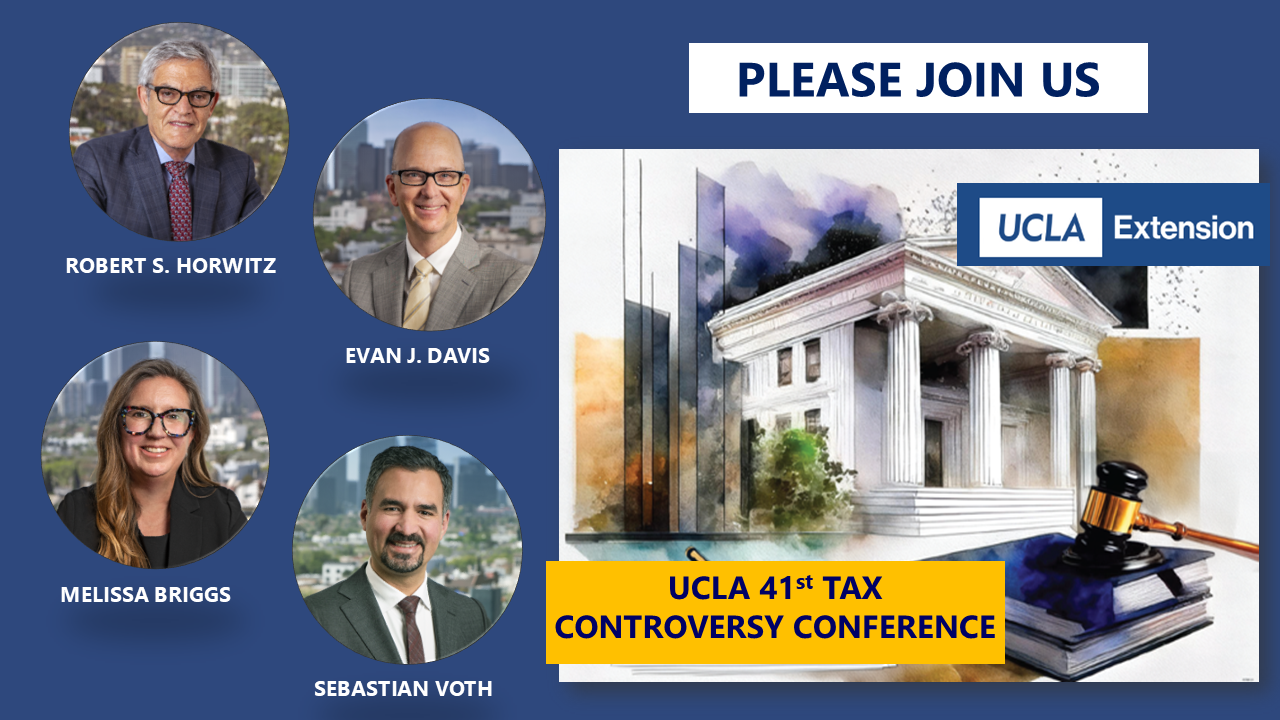
We are pleased to announce that Michel R. Stein and Robert S. Horwitz will be speaking at the upcoming CalCPA Federal and State Residency Issues webinar, Thursday, February 27, 2025, 9:00 a.m. – 10:30 a.m. (PST).
This webinar will guide tax professionals and advisers on the latest IRS examination guidance on U.S. residency and California residency issues The panel will discuss federal and state tax residency rules, California residency issues, income allocation issues in the residency context, managing residency audits, and best practices for advising clients who are considering leaving California. The IRS LB&I unit has issued examination guidance focused on taxpayer residency. California state tax residency rules, and an increase in residency audits and enforcement require tax professionals to know state residency and income allocation issues, so they can properly advise their clients when these issues arise.
We are pleased to announce that Steven Toscher Michel R. Stein and Philipp Behrendt will be speaking at the upcoming Strafford Cryptocurrency Tax Compliance: Tax Filing Requirements, Managing IRS Examinations webinar, Tuesday, February 25, 2025, 10:00 a.m. – 11:30 a.m. (PST).
The IRS continues to press its concern over massive under-reporting of income from cryptocurrency and other digital asset transactions. Tax advisers for clients with cryptocurrency holdings must understand the reporting requirements for transfers and the IRS scrutiny cryptocurrency investors are likely to face in the future.
Cryptocurrency is a digital asset using cryptographic techniques–rather than a central authority–to secure transfer currency units. Uniquely, no bank or government authority records the transfer of funds. And yet, the digital asset world will see its own Information Reporting (1099-DA) beginning with transactions in 2025.
The rise of Bitcoin’s value has prompted a massive compliance initiative aimed to identify taxpayers’ gain with audits going back to inceptions of the taxpayer’s trading activity. The IRS treats digital assets as property rather than currency for U.S. tax purposes. As a result, any transaction involving cryptocurrency is treated as a taxable sale or exchange of property, with taxpayers responsible for tracking their cost basis, gains, and losses.
We will discuss IRS enforcement actions focused on digital assets, providing an overview of the IRS’s guidance on various transactions, and provide practical guidance on the U.S. tax reporting obligations arising from cryptocurrency transactions.
We are pleased to announce that Steven Toscher along with Michael Desmond (Miller & Chevalier Chartered) and Ellen Aprill (UCLA School of Law) will be speaking on Loper Bright – The End of Chevron Deference for Treasury Regulations? at the upcoming UCLA Law 28th Annual Western Conference on Tax-Exempt Organizations which will take place at The California Endowment, Thursday, February 27, 2025, 2:30 p.m. – 3:45 p.m. (PST).
Steven Toscher is a Principal of the law firm Hochman Salkin Toscher Perez P.C., where he specializes in civil and criminal tax controversy and litigation. He is a Certified Tax Specialist in Taxation, the State Bar of California Board of Legal Specialization, a Fellow of the American College of Tax Counsel and has received an “AV” rating from Martindale Hubbell. Mr. Toscher was the 2018 recipient of the Joanne M. Garvey Award. The award is given annually to recognize lifetime achievement and outstanding contributions to the field of tax law by a senior member of the California tax bar. Mr. Toscher is the 2024 recipient of the prestigious Jules Ritholz Memorial Merit Award presented by the Civil and Criminal Tax Penalties Committee of the Taxation Section of the American Bar Association. The Jules Ritholz Memorial Merit Award recognizes lawyers who have demonstrated outstanding dedication, achievement and integrity in the field of civil and criminal tax controversies.
Hochman Salkin Toscher Perez attorney Philipp Behrendt was recently quoted in Tax Notes Federal regarding finalizing the Treasury Department’s decentralized finance (DeFi) broker reporting regulations. The article, titled The Sweeping Reach of the DeFi Broker Reporting Regulations by Lee A. Sheppard (posted Feb. 10, 2025) (subscription required), explores current legal challenges the new regulation faces through the lawsuit filed by Blockchain Association, along with the DeFi Education Fund and the Texas Blockchain Council in the U.S. District Court for the Northern District of Texas (Docket no. 3:24-cv-03259-X).
The Treasury Department’s final regulations under section 6045 expand the definition of “brokers” and the current regulation defines DeFi front-end service providers as brokers—entities that function as user interfaces for DeFi protocols. These regulations impose customer reporting obligations on these services, even if they do not take custody of digital assets. Critics argue that such an approach is overly broad, technologically unworkable, and may ultimately push DeFi activity offshore.
Behrendt on the Risks of DeFi Front-End Reporting
Philipp Behrendt commented on one of the core concerns surrounding the new regulations: the security risks and liability issues that come with requiring DeFi front-end services to collect and store customer data.
“Forcing DeFi front-ends to store sensitive user data would create a single point of failure, undermining both security and privacy. The liability for front-end operators that would come with a potential data breach might be in and of itself discouraging,” Behrendt stated. “The regulations acknowledge that but justify the implementation by arguing that this risk is the same for all other brokers as well. However, this justification may not adequately account for the unique vulnerabilities in the DeFi ecosystem.”
While traditional financial institutions have long been subject to customer reporting obligations, DeFi operates in a fundamentally different technological environment. DeFi front-end services merely provide access to self-executing smart contracts on public blockchains. Unlike conventional brokers, these platforms do not intermediate transactions, raising fundamental questions about whether the statutory definition of a broker truly applies.
The Legal Challenge and the Overreach of the Treasury’s Interpretation
A legal challenge filed by industry groups Blockchain Association, Texas Blockchain Council, and DeFi Education Fund asserts that the Treasury’s interpretation of “broker” under section 6045 is overly expansive and conflicts with the statutory language.
Behrendt pointed out that the Treasury’s comparison of DeFi front-ends to traditional brokerage interfaces faces challenges:
“The core issue remains the Treasury/IRS’s overbroad reading of the statute, which effectively turns a line of communication to a broker into a broker itself,” Behrendt explained. “In the regulations, the comparison is drawn between DeFi front-end services and apps that traditional brokers use to communicate with clients. However, the regulations fail, in my opinion, to recognize a key distinction: In traditional brokerage systems, these communication tools are integrated into a broker’s operations but do not define the entity as a broker.”
One potential legal battleground is statutory interpretation, which was fundamentally reshaped by the Supreme Court’s decision in Loper Bright Enterprises Inc. v. Raimondo last year. In that ruling, the Court overturned the so-called Chevron deference, which had previously required courts to grant broad leeway to agency interpretations of ambiguous statutes. Behrendt was quoted that the court may not even need to invoke Loper Bright if it finds that the regulations exceed the authority granted by Congress, making the case a direct challenge to the Treasury’s statutory overreach:
“If courts agree that front-end services merely channel user inputs and that their service does not ‘effectuate’ transfers, the Treasury/IRS’s approach may fail under a proper statutory interpretation even without Loper Bright,” Behrendt commented.
Conclusion
The Treasury Department and IRS have taken what they consider a necessary step toward tax compliance. There is no doubt that they conducted a detailed analysis of the DeFi ecosystem’s layered structure, significantly refining their regulatory approach from the initial proposed regulations to develop a reporting framework that is, in their view, minimally intrusive, practical, and yet effective. Rather than imposing reporting obligations directly on DeFi protocols, the final regulations shift the burden to an earlier stage—front-end service providers.
Opponents argue that this approach stretches the statutory definition of “broker” beyond recognition, raising serious security and operational concerns.
As the legal battle unfolds, the key question will be whether courts uphold the Treasury’s interpretation or determine that DeFi front-end services fall outside the intended scope of section 6045. Behrendt’s insights suggest that this case could shape the future regulatory landscape for DeFi in the United States, with far-reaching implications for the industry.
Stay tuned for further updates on this pivotal legal challenge.
We are pleased to announce that Michel R. Stein and Robert S. Horwitz will be speaking at the upcoming CalCPA Federal and State Residency Issues webinar, Tuesday, February 11, 2025, 9:00 a.m. – 10:30 a.m. (PST).
This webinar will guide tax professionals and advisers on the latest IRS examination guidance on U.S. residency and California residency issues The panel will discuss federal and state tax residency rules, California residency issues, income allocation issues in the residency context, managing residency audits, and best practices for advising clients who are considering leaving California. The IRS LB&I unit has issued examination guidance focused on taxpayer residency. California state tax residency rules, and an increase in residency audits and enforcement require tax professionals to know state residency and income allocation issues, so they can properly advise their clients when these issues arise.
Legal Disclaimer. This Report only provides general information about the law and does not, under any circumstances, constitute legal advice in any manner. The facts of each situation are unique and you should not act or refrain from acting in any manner based on any information contained or referenced in this Report at any time without first obtaining the advice of competent professional legal counsel. This site contains links to third-party internet sites. We are not responsible in any manner for, and make no representations or endorsements of any kind whatsoever with respect to, any third-party internet sites or with respect to any information, products or services that such internet sites might offer or provide.