
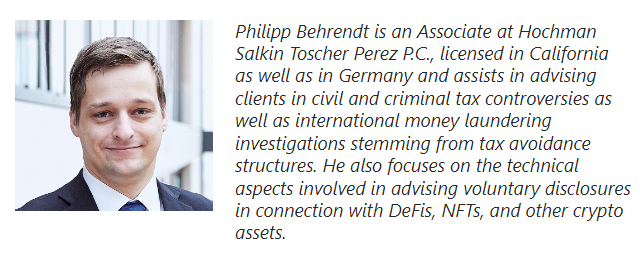
Philipp Behrendt was quoted in Tax Notes Article on the question whether the IRS get a percentage after a crypto 51 percent attack (Posted on Apr. 16, 2024, by Nathan J. Richman and Mary Katherine Browne).
The article explores the question whether the IRS position on the worthlessness of digital asset is applicable to losses occurring a taxpayer may experience if certain blockchain networks become the target of 51% attacks.
The IRS Chief Counsel Advice from January 10, 2023 (ILM 202302011) is unclear in many aspects and does cover a fictional scenario that does not translate into a likely real-world event.
Furthermore, as Philipp noted, “To big network, [a 51% attack is] not a real risk. They are too powerful… . It’s just too expensive, prohibitively expensive”. Philipp explained that “[w]ith 2 percent more hashing power — 51 percent versus 49 percent — the attackers can get their work done just that much faster than anyone else” and “[i]f you have two different miners who come to different results in a block, the blockchain basically splits, so the longest one is the one that will be followed. Since you have more computational power, you are basically able to create the longest blockchain”.
Attackers would need unique, hard to acquire, and expensive equipment to launch a successful attack on a Proof-of-Work network (or invest significant amounts to acquire sufficient stakes, in Proof-of-Stake network). And larger networks, such as Bitcoin, have additional defense strategies in place.
Click Here for Link to the Article
 TAXLITIGATOR - Tax Controversy (Civil & Criminal) Report
Leave a comment